Chapter 20 of 25 — contents
- 01What a Trading Engine Actually Is
- 02qkt as a Subject
- 03The Event Bus
- 04Candles
- 05Position Tracking and P&L
- 06The Risk Engine
- 07Exact Arithmetic
- 08Deterministic Replay
- 09Backtest Reporting
- 10Parameter Sweeps and Walk-Forward Analysis
- 11Backtest Fidelity
- 12Why a DSL
- 13Parsing and Compiling
- 14Indicators
- 15Historical Data
- 16The Live Runtime
- 17Brokers
- 18The Order Lifecycle
- 19Resilience
- 20Backtest/Live Parity
- 21Portfolios
- 22Observability
- 23Performance
- 24One Strategy, End to End
- 25What Building qkt Teaches About Trading Systems in General
Backtest/Live Parity
The sentence the whole book has been serving#
Chapter 1 stated a requirement and then spent nineteen chapters paying for it:
The same strategy must produce the same decisions whether it’s looking at historical data played back in a simulator, or at real prices arriving from the real market, right now.
Almost everything since has been an instalment on that sentence. The event bus assigning one order. The clock being handed in rather than consulted. The ledger having exactly one writer. Money that is exact rather than close. A language strict enough that “it compiles” means something. A broker layer that refuses to claim capabilities it can only approximate.
This chapter is where the bill is totalled — and where the claim has to be stated precisely enough to be falsifiable, because a vague promise of “backtest and live agree” is worth nothing at all.
Four things that have to be the same#
The requirement decomposes into four invariants. They are this book’s framing rather than a phrase you will find written in the source, but each one has been earned by a chapter, and every known divergence traces back to one of them.
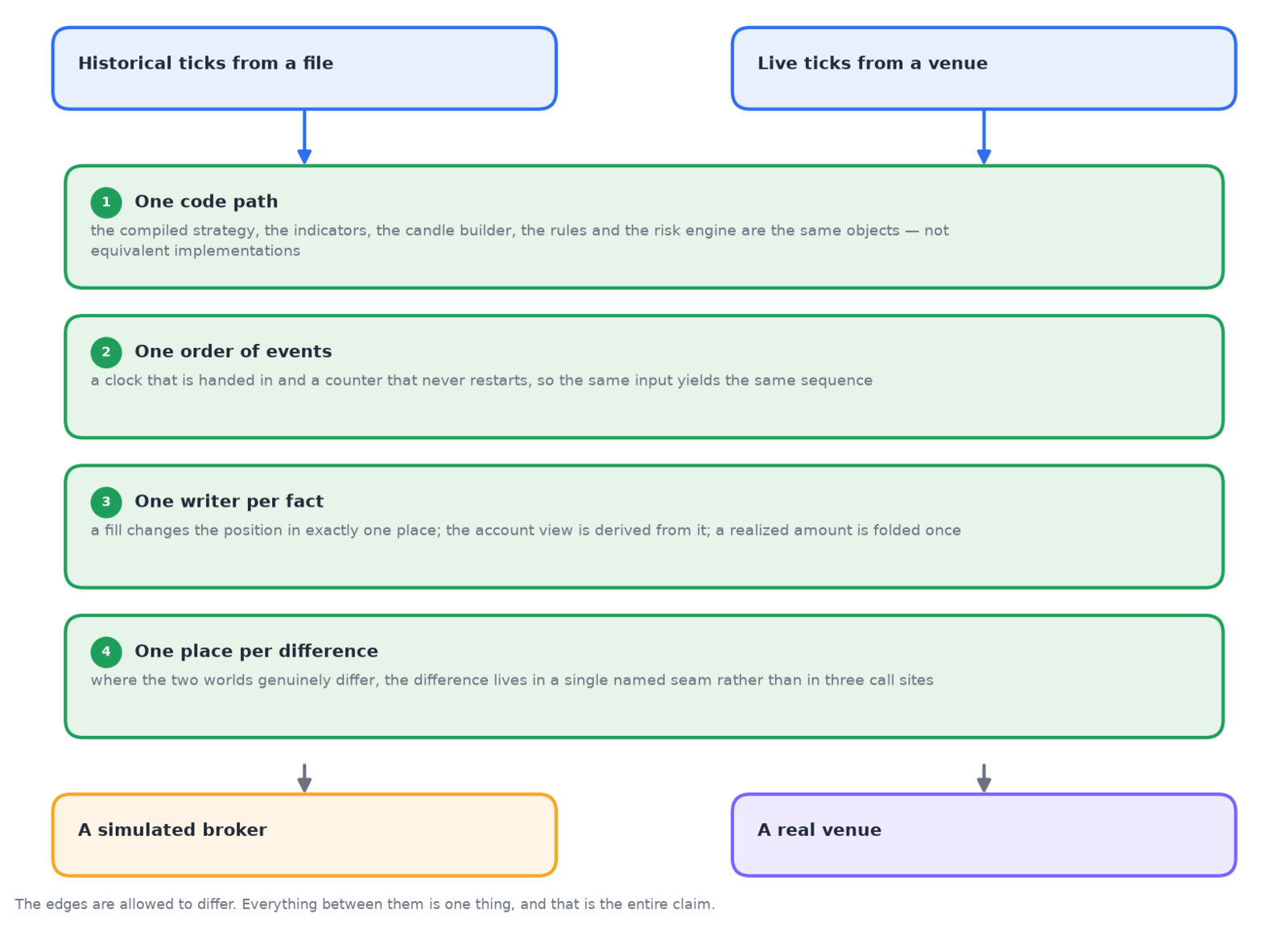
Figure 20.1 — the shape of the claim. Two different inputs and two different outputs, with one identical middle.
One code path. Not “equivalent implementations” — the same objects. The compiled strategy, the indicator instances, the candle builder, the rules, the risk engine. Chapter 8 established why a second implementation would be fatal: two codebases drift, and the drift is invisible until the numbers stop matching for real money.
One order of events. A clock handed to the engine rather than read from the machine, and a sequence counter that resolves ties. The same input yields the same sequence, every time, on any machine.
One writer per fact. A fill changes the position in exactly one place. The account view is an index derived from that ledger, never a second thing anyone writes to. Every realized amount is priced once and folded once. Chapter 5’s argument, restated as a parity requirement: two writers can disagree, and if they can disagree in live they can disagree differently in backtest.
One place per difference. Where the two worlds genuinely differ, the difference lives in a single named seam. The clearest example is two functions and a comment:
/**
 * The price a BUY executes at — the ask, falling back to the tick's single price
 * (mid for quote-driven feeds) when the feed carries no quote depth. Trigger checks
 * must use this side: MT5 fires BUY_STOP on the ask, so an engine or simulator that
 * triggers on mid is systematically ~half a spread optimistic per trigger event.
 */
fun Tick.buyExecPrice(): BigDecimal = ask ?: price

/** The price a SELL executes at — the bid; see [buyExecPrice]. */
fun Tick.sellExecPrice(): BigDecimal = bid ?: price
Read the size of that error: half a spread, on every trigger event. On gold, that is a few cents; over ten thousand triggers it is a meaningful fraction of a strategy’s edge, and it always points the same way — in your favour, in the backtest, and not in real life. It is invisible in any single trade and decisive in aggregate.
The fix is not a patch at each call site. It is that there is now exactly one place in the system that answers which side does this execute against, and everything routes through it. Any future code that triggers on the wrong side has to go out of its way to do so.
What is actually compared#
An invariant nobody checks is a wish, so the checking is worth seeing.
The parity harness takes one strategy source and does something more paranoid than it first appears: it compiles it twice, independently — once for each mode. That detail matters. Sharing a compiled object between the two runs would prove the runtime is deterministic while quietly assuming the compiler is. Compiling twice tests both.
It then drives the identical tick list through a backtest and through a live session, and captures the same five things from each:
data class Snapshot(
    val trades: List<TradeState>,
    val positions: List<PositionState>,
    val pnl: PnlState,
    val rejections: List<RejectionState>,
    val halts: List<HaltState>,
)

data class Result(val backtest: Snapshot, val live: Snapshot)
And the comparison is one line, with no tolerance in it anywhere:
assertThat(result.live).isEqualTo(result.backtest)That is exact structural equality over whole domain objects — not a hash, not “within a penny.” Note what is in the snapshot besides trades: rejections and halts. A run where both sides made the same trades but one of them rejected an order the other allowed is a failure. The comparison covers the decisions not to trade as well as the decisions to.
The one concession is that numbers are normalised to a canonical string
before comparison, so a difference in decimal scale — 1.50 against
1.5 — cannot produce a false mismatch, while any difference in value
still does.
That covers everything above the broker. For the broker itself there is a narrower and more expensive proof: recorded ticks and order submissions from a real venue, replayed against the venue simulator, checking that acceptance decisions match — down to the venue’s own numeric rejection code, its retcode — and that fills agree within the instrument’s own tolerances.
The claim, stated honestly#
Here is where a lesser book would declare victory. The documentation doesn’t, and the precision is the most valuable thing in this chapter.
What the main harness proves is:
Backtest + PaperBroker === LiveSession + PaperBrokerAnd the docs say, in as many words, that this does not prove
Backtest === LiveSession + a real venue.
Read those two lines together and you have the honest shape of the whole enterprise. Everything above the broker is proven identical. The broker is where the proof stops, and the evidence there is narrower: it demonstrates one demo market-fill shape. It does not demonstrate cancellation races, partial fills, rejection codes, latency distributions, or a second venue.
A system that claimed more than that would be claiming something it cannot know.
Not every difference is a defect#
Which leads to the mechanism that makes this manageable: qkt keeps a catalogue of known divergences, and the catalogue’s most useful feature is that it sorts them into three kinds.
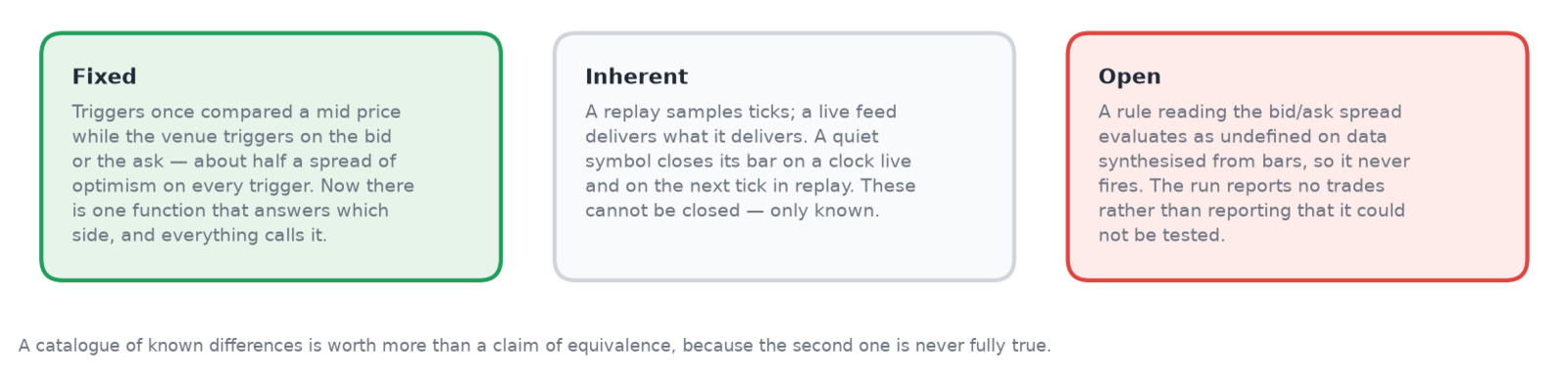
Figure 20.2 — the same document holds all three, and conflating them is how a divergence list becomes useless.
Fixed ones were real and are closed — the mid-versus-bid trigger being the cleanest example.
Inherent ones cannot be closed, and saying so is the point. A replay samples ticks; a live feed delivers whatever it delivers. A quiet symbol’s bar closes on a wall clock in live and on the next tick in replay — Chapter 4’s heartbeat, which exists because live has a clock replay doesn’t. A margin floor only applies where there is a real account. Listing these as permanent properties rather than open bugs is what stops a divergence list from being a backlog nobody can ever finish.
Open ones are known, unresolved, and stated. The one worth carrying out of this book: a rule that reads the bid/ask spread evaluates as undefined on data synthesised from bars, so it never fires. A backtest of a spread-aware strategy on bar data reports zero trades — not “this could not be tested,” just zero. It is exactly Chapter 4’s compression problem and Chapter 14’s undefined-value discipline meeting in the worst possible place, and the system detects the combination and warns rather than pretending.
Proving it about a specific build#
There is one more layer, and it is about a different question: not “is the design sound” but “did this exact build behave, on a real venue, for hours.”
A session can capture its own evidence — a checksummed bundle of the journals it produced, refusing to produce one if any events were dropped — and that bundle can be materialised back into replay stores, so a live session becomes a reproducible replay.
Promotion to production then requires a set of sibling artifacts covering health, journal, reconciliation, coverage, parity and insights, all checksummed, all pinned to one commit and one image digest, with a ledger of used run identifiers so a previous attestation cannot be replayed as a new one. Zero parity mismatches, zero unexplained rejections, zero unexplained order outcomes.
That is a different kind of claim from the harness — evidence about one build on one day rather than a property of the design — and it is the one that actually gates real money.
What parity is, and what it is not#
What it bought is the thing Chapter 1 said was the whole ballgame: a backtest number that is a statement about the system that will actually trade, rather than about a similar system that resembles it.
The costs have been itemised chapter by chapter, and they are not small. An order of magnitude of backtest speed, given up to avoid a second engine. A language that refuses rather than accommodates. A ledger that re-derives instead of incrementing. Startup that fails closed. All of it in service of one property.
And what it explicitly does not buy is worth ending on, because it is the difference between a rigorous system and an overconfident one. Parity means the decisions match. It does not mean the outcomes will. The venue still has latency the simulator does not model, rejection codes it has never seen, a spread that was not in the data, and a queue you were never in. Chapter 11’s coin flip is still a coin flip.
What parity gives you is narrower and more valuable than a promise about the future: when a backtest and a live run disagree, you know the disagreement is in the execution layer — because everything above it has been proven identical, and the things that genuinely differ are written down in a list you can read.