Chapter 2 of 25 — contents
- 01What a Trading Engine Actually Is
- 02qkt as a Subject
- 03The Event Bus
- 04Candles
- 05Position Tracking and P&L
- 06The Risk Engine
- 07Exact Arithmetic
- 08Deterministic Replay
- 09Backtest Reporting
- 10Parameter Sweeps and Walk-Forward Analysis
- 11Backtest Fidelity
- 12Why a DSL
- 13Parsing and Compiling
- 14Indicators
- 15Historical Data
- 16The Live Runtime
- 17Brokers
- 18The Order Lifecycle
- 19Resilience
- 20Backtest/Live Parity
- 21Portfolios
- 22Observability
- 23Performance
- 24One Strategy, End to End
- 25What Building qkt Teaches About Trading Systems in General
qkt as a Subject
Chapter 1 ended with a sketch of the loop: three types, about twenty lines. And it isn’t wrong, either — a tick arrives, the strategy decides, the broker answers, the books update. That genuinely is what a trading engine does.
qkt is 655 Kotlin source files and about 95,000 lines of engine code — twice that once you count the tests — across just over 2,500 commits.
The distance between those two numbers is what this chapter is about. Not because the sketch was a lie; it wasn’t. But everything between this describes the loop and this can be trusted with money turned out to live in the gap between twenty lines and ninety-five thousand. That’s a small production system, and every decision inside it was made under the pressure of having to keep working as it grew — not “this is fine for a demo.”
The module map, and what it tells you#
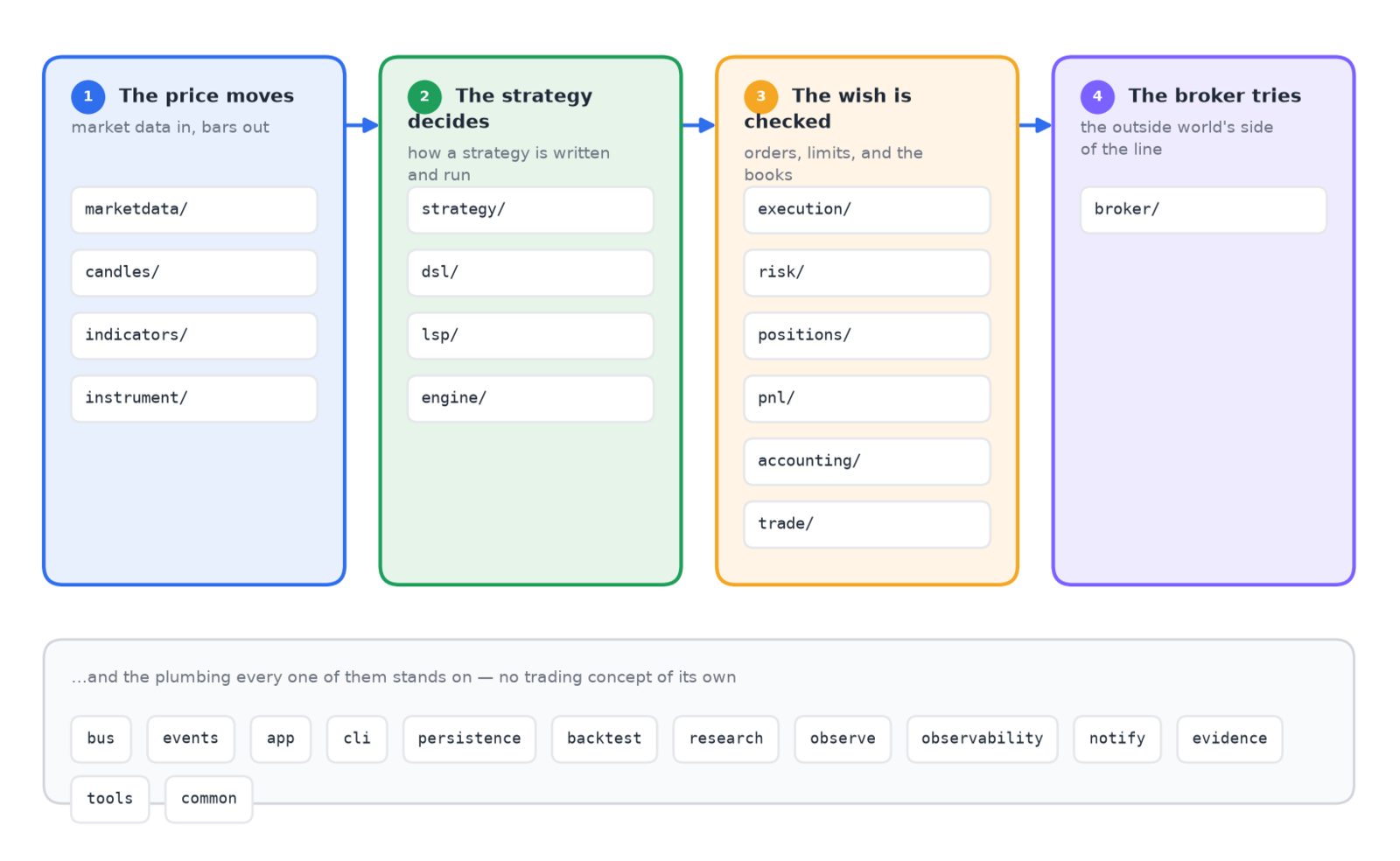
Figure 2.1 — the folders are the loop. Every package with a trading concept in its name sits on one of the four stages from Figure 1.2; the rest is plumbing those stages stand on.
Twenty-eight top-level packages, and notice what they’re named after:
trading concepts — broker, risk, positions, pnl, dsl — not technical
roles like service, repository, controller, dto. This is a real,
deliberate choice, and it’s worth understanding the alternative it
rejected.
A lot of software defaults to organizing by technical layer: all the
“services” in one folder, all the “models” in another, all the
“controllers” in a third. That layout makes sense when the interesting
complexity in your system is architectural — how requests flow through
layers. But in a trading engine, the interesting complexity is domain
complexity: what’s the difference between a resting order (one waiting at
the venue for its price) and a filled one; how a trailing stop (a stop
that follows the price up behind a winning trade) interacts with a
bracket (an entry with its stop and its target attached); what happens
when a broker reports a position the engine didn’t expect. None of that
complexity lives “in the service layer” — it lives in the concepts
themselves. So qkt organizes around the concepts. If you want to
understand risk halts, you go to one folder, risk/, and everything
about risk is there — not scattered across a services/RiskService.kt, a
models/RiskLimit.kt, and a controllers/RiskController.kt three folders
apart.
The tradeoff, honestly: package-by-domain can get you duplicate-looking utility code across packages, because you’re optimizing for “everything about X is together” over “no code is ever duplicated.” qkt’s engineering norms explicitly accept that cost — small, focused files (their own convention caps most files around 150 lines) over clever cross-cutting abstractions.
There’s a package here that might surprise you: lsp/. That’s a
Language Server Protocol implementation — qkt ships editor tooling
(autocomplete, error-checking) for its own strategy-description language,
the same protocol VS Code and Neovim use for every serious programming
language. Notice what that says about priorities: this project treats “a
human has to write strategies in this language comfortably” as seriously
as it treats the execution engine itself.
The tech stack, and why Kotlin#
plugins {
    alias(libs.plugins.kotlin.jvm)
    alias(libs.plugins.kotlin.serialization)
    application
    alias(libs.plugins.ktlint)
    alias(libs.plugins.dokka)
}
Kotlin, on the JVM. Worth asking: why not Python (the default choice for anything “quant”), why not Rust or C++ (the default choice for anything “low-latency”), why not Go?
- Python is the lingua franca of research and data science — pandas,
numpy, the whole ecosystem. But Python’s dynamic typing is a liability
the moment you’re handling money and orders: a strategy that silently
receives
Nonewhere it expected a price, or afloatwhere you needed exact decimal math, fails at runtime, maybe after money has already moved. Python is also slow enough that a tick-by-tick engine written naively in it becomes a genuine latency problem well before you’d hit any real trading volume. - Rust or C++ would win on raw speed and memory control, which matters somewhere in a trading system — but that somewhere is a narrow hot path, not the whole system. Paying C++‘s tax (manual memory management, longer iteration cycles, a much smaller pool of contributors who can safely touch the codebase) across the entire surface — DSL parsing, reporting, CLI tooling, brokers — is a bad trade when only a sliver of the code is actually latency-critical.
- Kotlin sits in a sweet spot for this specific job: it compiles to
the JVM (mature, fast, garbage-collected but predictably so if you’re
careful about allocation and blocking calls on the hot path), it has
real static types and null-safety baked into the
language (that
Trade?nullable-return pattern from Chapter 1 is a language feature, not a convention you have to enforce by hand), and it reads almost as concisely as Python while catching entire categories of bugs at compile time that Python only catches in production. The JVM also means access to a huge, battle-tested ecosystem — logging (slf4j/logback), HTTP (okhttp), serialization — without writing any of that from scratch.
The real lesson here isn’t “Kotlin is the best language” — it’s that the choice was made by weighing where the speed actually matters (a narrow hot path) against where correctness and iteration speed matter far more (everything else), and picking the language that serves the larger set well while still being fast enough where it counts.
The rest of that dependency list holds two choices that can be made in a
sentence and one worth slowing down for. ktlint formats the code as part
of the build rather than as a polite request, and dokka generates the API
documentation out of the code’s own comments — both are the same move,
which is taking a convention that reliably decays when humans maintain it
and making the build responsible for it instead.
The interesting one is what’s absent. There is no mocking framework here at all — no Mockito, no MockK — in a 95,000-line codebase where you would expect one as a matter of course.
Think about what a mock actually asserts. Write the usual “verify that
execute was called with this order” and the test passes when one
particular method received one particular argument. That’s a claim about
how the code is written, not about what it does. Rename the method,
split it in two, route the call through a new collaborator, and the test
goes red while the system’s behaviour is byte-for-byte what it was
yesterday. Do that a few dozen times and everyone learns that a red test
means somebody moved some code, which is precisely the moment a test suite
stops protecting anything.
So every stand-in in qkt’s tests is a small real object instead: a paper broker that actually fills an order, a fixed clock that actually reports the time it was handed. They cost a few more lines to write than a mock would, and what that buys is assertions about outcomes — this trade ended up at this price, this position ended up flat — which survive any refactor that doesn’t change what the system does. For a codebase whose whole safety argument is replay the history and compare the numbers, tests that assert on numbers rather than on call sequences are the only kind that fit the argument.
The discipline as a case study, not a bureaucracy#
Here’s something worth taking seriously as a lesson in its own right, independent of trading: qkt enforces a one-way promotion pipeline across three branches.
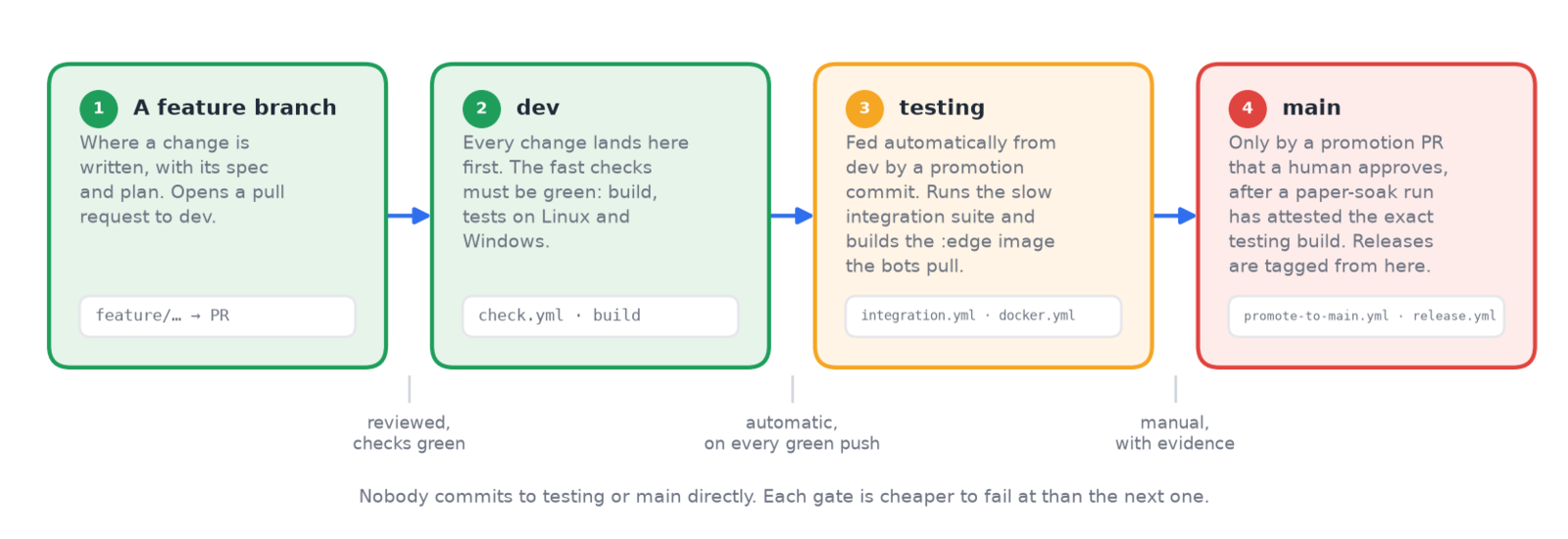
Figure 2.2 — one direction only. Code enters at the left and can only move right, and each gate is a different kind of check: fast tests, then the slow integration suite, then a human holding a piece of evidence.
Three branches, and code only ever moves rightward. Changes land on dev
behind a review and fast tests; testing receives no human commits at
all, only automatic promotions from green builds; main is reachable only
through a promotion request that a person merges.
The gate onto main is the one that isn’t generic software hygiene. It
cannot be opened by a passing test suite. It requires a paper-soak —
the exact testing build, running for hours against a live demo venue,
producing an attestation tied to that specific commit. Tests prove the
code does what its author expected. A soak is the only thing that can say
this build survived contact with a real venue’s timing, its rejections,
and its silences. Chapter 20 is where that distinction gets its proper
treatment; the point here is that qkt treats it as a release gate rather
than as reassurance.
That is also why the pipeline is one-way. In a system that moves real money, finding out something is broken after it is live is not “we’ll patch it later” — it is a loss that has already happened, and a branch you can only move forward through is a structure where skipping the check is impossible rather than merely discouraged.
This is worth naming explicitly, because it’s the same instinct that makes a trading system itself trustworthy, just applied one level up, to the process of building the trading system: a decision without a recorded reason is a decision nobody can safely revisit. In the engine, that shows up as reachable-yet-unmodeled outcomes — a rejection, a null price — being represented deliberately rather than papered over. In the engineering process, it shows up as “don’t ship a feature without writing down why it’s shaped the way it is.” Same discipline, two different layers.