Chapter 14 of 25 — contents
- 01What a Trading Engine Actually Is
- 02qkt as a Subject
- 03The Event Bus
- 04Candles
- 05Position Tracking and P&L
- 06The Risk Engine
- 07Exact Arithmetic
- 08Deterministic Replay
- 09Backtest Reporting
- 10Parameter Sweeps and Walk-Forward Analysis
- 11Backtest Fidelity
- 12Why a DSL
- 13Parsing and Compiling
- 14Indicators
- 15Historical Data
- 16The Live Runtime
- 17Brokers
- 18The Order Lifecycle
- 19Resilience
- 20Backtest/Live Parity
- 21Portfolios
- 22Observability
- 23Performance
- 24One Strategy, End to End
- 25What Building qkt Teaches About Trading Systems in General
Indicators
The layer everyone assumes is simple#
An indicator is the most familiar object in trading software. A moving average is an average. A Bollinger band is a mean plus so many standard deviations. Ask anyone who has used a charting package and they will tell you an indicator is a formula, and they will be right.
The formula is not where the difficulty is. The difficulty is that an indicator is a stateful thing living in a stream of time, and almost every interesting problem in this chapter comes from that sentence rather than from any of the maths.
Three of those problems are worth the chapter. When is an indicator’s answer allowed to be trusted? What happens when the answer doesn’t exist? And what happens when a rule wants to compare two streams that don’t tick at the same time?
An answer, or the absence of one#
Start with the smallest piece. Every indicator in qkt exposes the same tiny surface — and it is split in two, which is the first thing worth noticing:
interface IndicatorOutput {
    /** Latest computed value, or `null` until [isReady] is true. */
    fun value(): BigDecimal?

    /** True once the indicator has received at least [warmupBars] samples. */
    val isReady: Boolean

    /** Number of inputs the indicator must observe before [value] returns non-null. */
    val warmupBars: Int
}

interface Indicator<TIn> : IndicatorOutput {
    /** Feed one input to the indicator. Effects on [value] / [isReady] are immediate. */
    fun update(input: TIn)
}
A strategy only ever sees the top half — the read side. Only the engine’s
binding layer holds the update half and pushes values in. A strategy
cannot feed an indicator, which means it cannot accidentally advance one
twice or feed it out of order.
Now the return type, which is the interesting part: the value is allowed
to be absent. value() returns BigDecimal?, and the source says
exactly how to treat that — “null from value means ‘not yet
computable’… Callers should treat null as a hard ‘skip this bar’ rather
than coalescing to zero.”
And notice warmupBars sitting right there on the interface. That is the
number Chapter 13’s compiler collects when it walks a strategy: the
indicator is asked, because only the indicator knows.
That instruction is the same discipline Chapter 7 spent a whole chapter on, arriving in a new place. An average of three bars when twenty-one are required is not zero, and it is not “close enough” — it is no answer, and the difference between representing that honestly and flattening it to a number is a rule that fires on a value nobody computed.
The absence shows up again from an unexpected direction: arithmetic that has no answer. The square root of a negative number, a logarithm of zero, a division by zero — each returns nothing rather than throwing or substituting. Because the language has a way to test for that, a strategy can say if this is undefined, do something else rather than crashing or, much worse, trading on a fabricated value.
Seeding: where the first number comes from#
An exponential moving average has a recursive definition — today’s value depends on yesterday’s. Which raises the obvious question: what is the value on the first day, when there is no yesterday?
qkt’s answer is the classical one, and worth seeing because it explains
the shape of every warmup number in this book. The first period inputs
are accumulated as a plain running sum, and the first reading emitted is
their simple average. Only from input period + 1 onward does the
exponential recurrence actually run.
So an ema(close, 21) does not produce a meaningful value until it has
seen twenty-one bars, and — critically — it does not produce a wrong
value before that. It produces nothing.
That is why Chapter 13’s warmup arithmetic asks each indicator how many
bars it needs rather than inferring from its arguments. The indicator
knows, because the indicator is the thing doing the seeding. MACD(12, 26, 9) answers thirty-four rather than twenty-six because its signal line is
an average of the MACD line, and cannot begin until that line exists.
Nothing outside the indicator could have worked that out without
re-deriving the maths.
The subtlest bug in the chapter#
Now the interesting one, and it is a case of two entirely reasonable decisions colliding.
Decision one: when a bar closes, every indicator is updated with it, and then rules are evaluated. Update, then fire. This is obviously right — a rule should see the freshest possible state, and any other order would mean rules reading yesterday’s indicators.
Decision two: highest(close, N) means what it says — the highest close
over the last N bars.
Put those together and write the single most common breakout rule in trading: buy when the close exceeds the highest close of the last twenty bars.
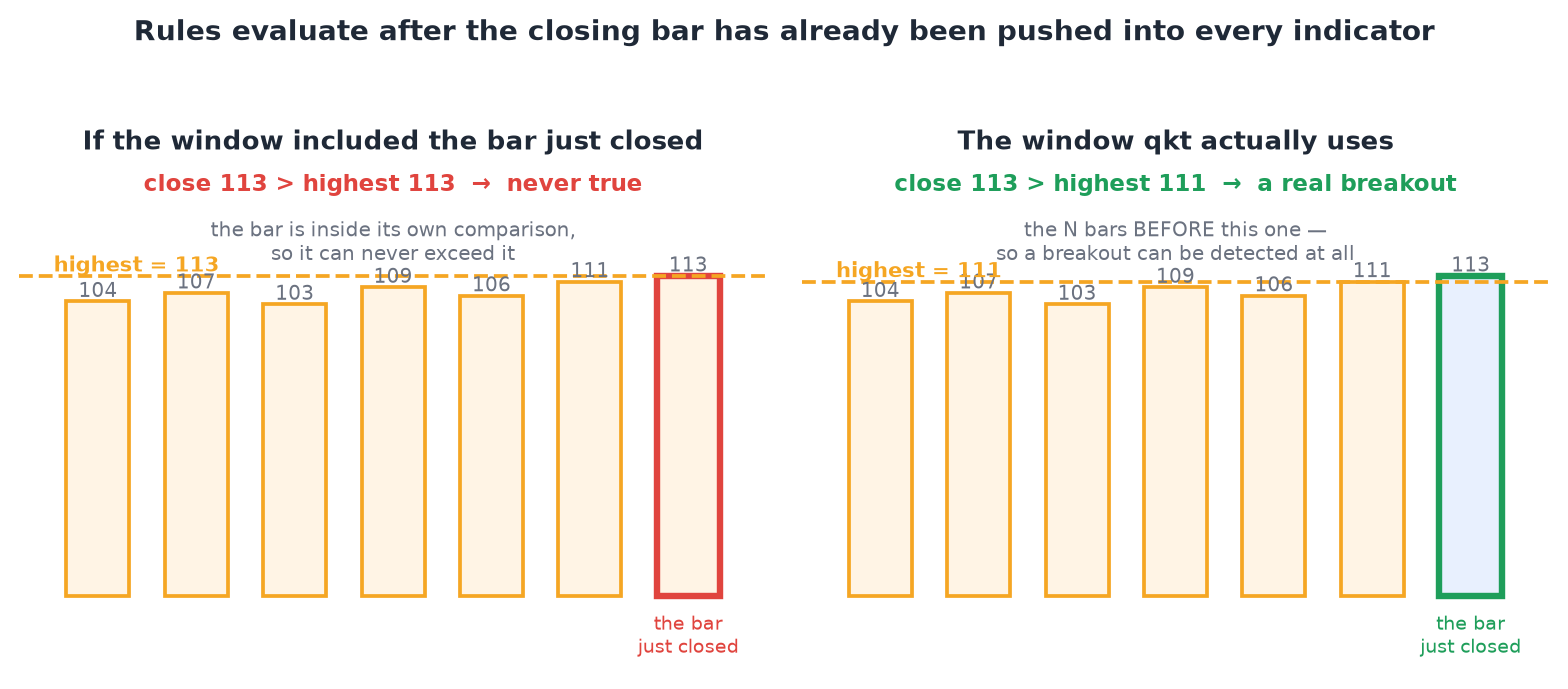
Figure 14.1 — the same closing bar, and the same rule, differing only in whether the window contains the bar being compared against it.
The bar closes at 113. It is pushed into the indicator. The indicator’s window now includes 113, so the highest close over the window is 113. The rule asks whether 113 is greater than 113. It is not. It never will be — not for this bar, not for any bar, not ever, because a value cannot exceed a maximum it is itself a member of. The rule is not merely wrong; it is unsatisfiable, and it fails silently, forever, on a strategy that looks completely reasonable.
qkt’s fix is to make HIGHEST and LOWEST — and only those two — report
the extreme over the N bars before the current one. The breakout rule
then means what its author intended: 113 against a prior high of 111 is a
breakout, and the rule fires.
Two things about this are worth sitting with. The first is that the fix lives in the indicator rather than in the documentation, because the alternative is asking every strategy author to remember to lag the window by hand, forever, and to notice when they forget — which is exactly the class of problem no one notices, since the symptom is nothing happening.
The second is that this is a genuine asymmetry, and it should be known rather than discovered. Every other rolling function in the catalogue includes the current bar. These two do not. That is defensible — it is what the trading vocabulary means by “breakout” — but it is a special case, and a reader who assumes uniformity will eventually be surprised by it.
What the catalogue is, and why it’s closed#
The catalogue is broad: moving averages in several flavours, oscillators, volatility measures, statistical functions — z-scores, regression slopes, percentile ranks, skew — plus candle-shape oscillators, volume measures, bands, directional movement, session-anchored measures like pivots and session VWAP, and cross-series measures like correlation and beta.
And it is closed. There is no way to define a new indicator from inside a
.qkt file. A genuinely new one is written in Kotlin, added to the
registry, and shipped in a build.
This is Chapter 12’s bargain arriving at its most concrete point. The registry is what makes the warmup walk possible — each entry knows its own bar requirement, so the compiler can ask. It is what makes the editor’s completions provably correct, because the editor reads the same table the compiler validates against. An extension point in the DSL would break both properties on the day someone used it.
There is a small, honest cost inside the catalogue worth naming. An indicator with several outputs — a MACD line, its signal, and their histogram — is exposed as several separate entries, and each one quietly runs its own private instance underneath. Referencing the MACD line and its signal in the same rule computes MACD twice. It is duplicated work in exchange for every catalogue entry being a simple, independent thing that binds the same way as any other. On the scale these run at, the trade is easy; it is still real, and a reader inspecting a profile would rather know than deduce it.
Two streams that don’t tick together#
The last problem is the one that arrives the moment a strategy stops looking at a single instrument.
Say a rule compares a one-minute stream against a five-minute one. The one-minute stream closes a bar every minute. The five-minute stream closes one every five. What should the rule do on the four one-minute closes that have no matching five-minute close?
Evaluating anyway is the tempting answer and it is wrong: the rule would fire against a five-minute bar that hasn’t finished forming, which is a value that will still change. So qkt buffers instead. Closed bars are collected, keyed by their end time, and the rule fires exactly once — when every stream in the group has reported for that window.
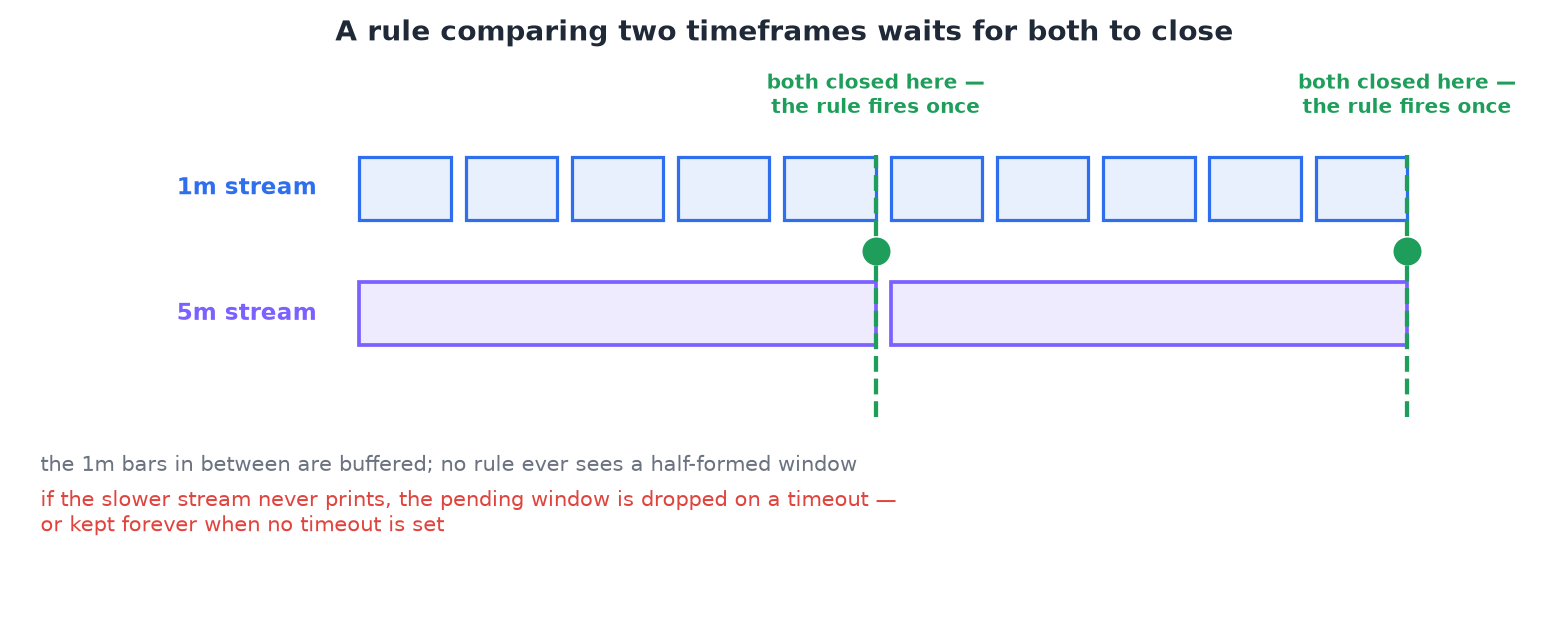
Figure 14.2 — a rule spanning two timeframes waits for the slower one. The intermediate bars are buffered, and no rule ever evaluates against a half-formed window.
That leaves one question the design has to answer honestly: what if the slower stream never prints? A venue goes quiet, a feed drops, and a window sits half-complete forever.
qkt lets a group carry a timeout. With one set, a window that falls too far behind is dropped — no rule fires for it, and the memory is released.
With no timeout set, a partial window is kept indefinitely. That is correct when both streams reliably print, and a slow memory leak when one of them stops. The source says as much in plain terms rather than pretending the unbounded case is safe.
There is a second way to combine instruments that avoids the problem entirely, and it’s worth knowing it exists: a basket — several instruments composited into one synthetic index, equal-weighted on log returns, based at 100. Because a basket is a stream, everything downstream treats it as one series and the alignment question never arises. Its first aligned window only establishes the baseline, so the first real value lands on the second window — a one-window warmup built into the maths rather than configured.
Right, absent, and never approximately right#
What the indicator layer bought is that a number a rule reads is either right or absent. It is never approximately right, never a partially-seeded value that looks plausible, and never a fabricated zero standing in for an answer that doesn’t exist. Every indicator knows its own warmup, which is what lets the compiler compute the strategy’s, which is what lets rules be gated before they can act.
What it cost is a closed catalogue, some duplicated computation for multi-output indicators, and one deliberate asymmetry a reader has to carry: the two rolling-extreme functions lag by a bar while nothing else does. And where two streams meet, it costs a choice — bound memory and occasionally drop a window, or keep every window and trust the feed.
That last one is the honest shape of most decisions in this book. There was no option that was safe in both directions; there was only the question of which failure the system should be built to survive, and whether the reader would be told which one was chosen.