Chapter 15 of 25 — contents
- 01What a Trading Engine Actually Is
- 02qkt as a Subject
- 03The Event Bus
- 04Candles
- 05Position Tracking and P&L
- 06The Risk Engine
- 07Exact Arithmetic
- 08Deterministic Replay
- 09Backtest Reporting
- 10Parameter Sweeps and Walk-Forward Analysis
- 11Backtest Fidelity
- 12Why a DSL
- 13Parsing and Compiling
- 14Indicators
- 15Historical Data
- 16The Live Runtime
- 17Brokers
- 18The Order Lifecycle
- 19Resilience
- 20Backtest/Live Parity
- 21Portfolios
- 22Observability
- 23Performance
- 24One Strategy, End to End
- 25What Building qkt Teaches About Trading Systems in General
Historical Data
The backtest that was quietly wrong#
Every number Chapters 8 through 11 produced rested on an assumption nobody stated: that the data underneath was actually there.
Picture a backtest over January. It runs, it reports a Sharpe ratio and a drawdown and a trade count, and every one of those numbers is computed correctly by the machinery already built. Now suppose the eighteenth of January is missing three hours in the middle of the session — a fetch that half-failed weeks ago, a file that exists and is short.
Nothing complains. The replay reads what is there. The strategy sees a market that went quiet for three hours and then jumped, which is a market that did not exist. Whatever it did in response is now in the report, indistinguishable from a real result.
This is a different failure from the ones in Chapter 11. There the ambiguity was in the format — four numbers cannot record a path. Here the data is simply absent, and absence has no representation at all. A missing hour looks exactly like an hour in which nothing happened.
So the job of this chapter is narrower than “storage” and more important than it sounds: knowing what you have.
Presence is not coverage#
Start with the distinction the whole design turns on.
The store keys its knowledge on files. One file per symbol per UTC day. Asking “do I have the eighteenth?” is a question about whether a file exists, which is fast, simple, and completely insufficient — because a file that exists can be empty, truncated, or missing the middle of the session.
The word for “the file is there” is presence. The word for “the data in it is actually the day” is coverage, and only the second one is worth anything.
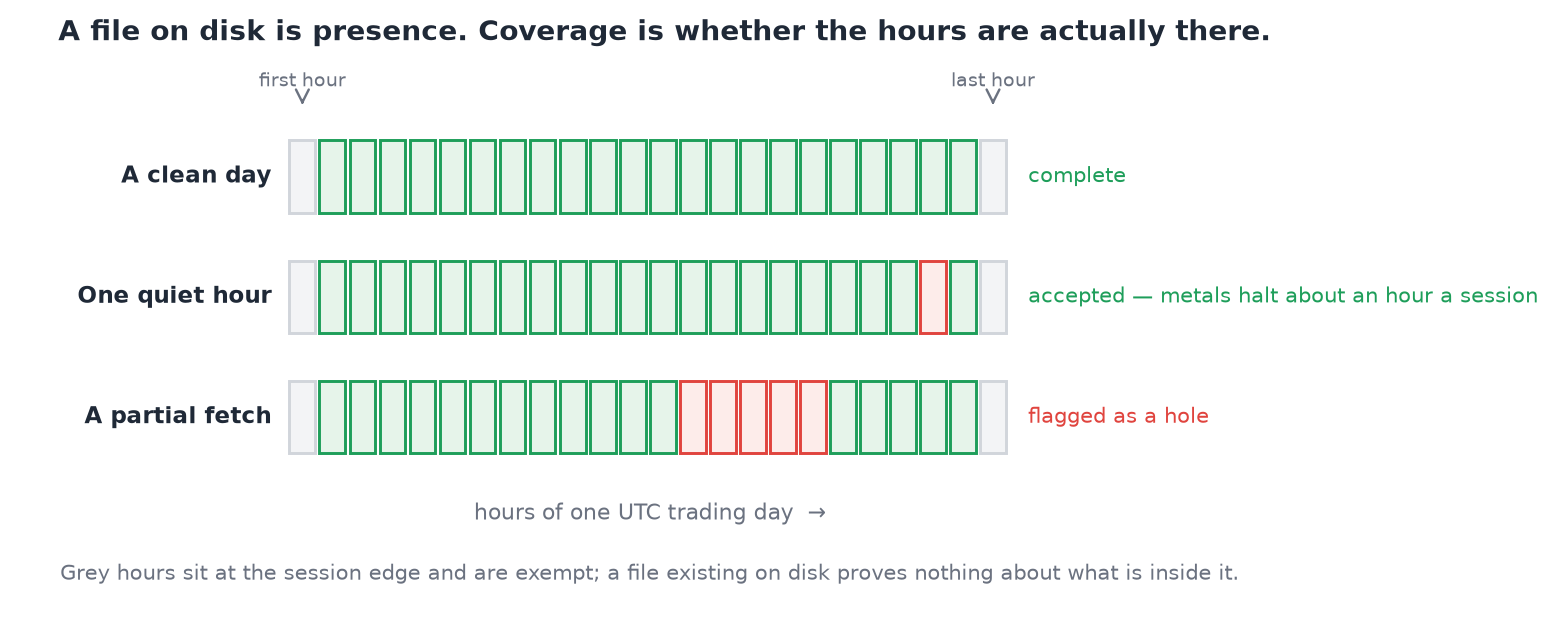
Figure 15.1 — the same question asked of three files that all exist. Coverage is checked hour by hour against the trading calendar, and the session’s first and last hours are exempt because they are legitimately thin.
Notice what the validator tolerates and what it doesn’t, because that line is a genuine piece of domain knowledge rather than a threshold someone picked. One isolated empty interior hour is accepted. Metals and FX halt for roughly an hour every session, and at the data layer a maintenance break is indistinguishable from a hole. Refusing to run on that would refuse to run on every normal day of gold data.
Several consecutive empty hours are not accepted, because that is what a genuinely failed or partial fetch actually looks like. The tolerance is sized to let the routine thing through and catch the broken thing, which is what a threshold is for.
The wall calendar is the wrong calendar for this, too. A Saturday with no ticks is not a hole. Coverage is checked against a trading calendar, so weekends and closures are absences the system expects rather than absences it reports.
What happens when a day is missing#
With coverage established, the rest of the pipeline follows.
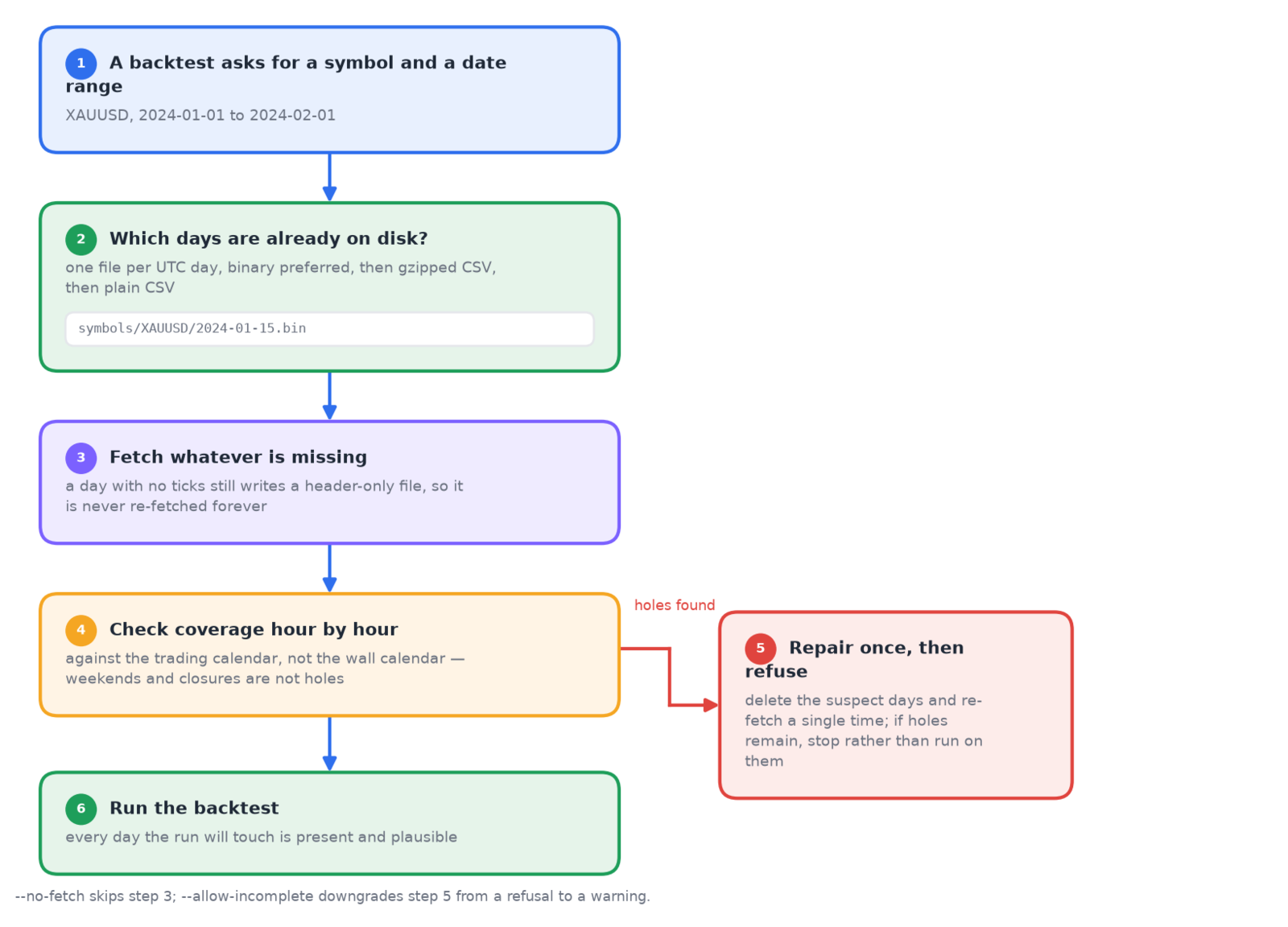
Figure 15.2 — the provisioning path. The interesting step is the fifth, which is the one that declines to continue.
Missing days get fetched. That part is ordinary except for one detail with a nice shape to it: a day that genuinely has no ticks still gets a file written — a header and nothing else. Without that, a quiet day would be absent, absence would mean “not fetched,” and every future run would try to fetch it again, forever. Writing the empty file is how the store records “I asked, and the answer was nothing.”
Then coverage is checked, and if there are holes the system gets exactly one repair attempt: delete the suspect days, fetch them again, re-check. Once. If holes remain after that, the run stops:
$ qkt backtest strategies/momentum.qkt --from 2024-01-15 --to 2024-01-16 ...

qkt: tick coverage BTCUSDT 0/1 trading days
qkt: error: incomplete data for BTCUSDT:
  2024-01-15  incomplete (empty hours 1,2,3,4,5,6,7,8,9,10,11,12,13,14,15,16,17,18,19,20,21,22)
  re-run with --allow-incomplete to proceed anyway
That refusal is the chapter’s whole argument, and it is worth noticing what it does not do. It does not silently proceed. It does not quietly interpolate. It names the symbol, names the day, lists the hours it couldn’t account for, and tells you the flag that overrides it.
The override exists, and it should. There are legitimate reasons to run on
partial data — you know the gap is real, you are testing something
unrelated to that window, you want a rough answer now. Passing
--allow-incomplete downgrades the refusal to a loud warning, printed
above the results so it travels with them. What the design refuses to do
is make that the default, because a default that runs on whatever happens
to be on disk produces exactly the confidently-wrong report this chapter
opened with.
There is a smaller, related guard worth mentioning: a freshly fetched day that looks empty, truncated, or gappy triggers a warning rather than a retry. The reasoning is stated plainly in the source — a genuinely quiet day is legitimately empty, and auto-refetching it would loop forever. Warn, don’t spin.
What the bytes look like#
The storage format is worth a short detour, because the choice is unusually legible.
Ticks and bars are stored in a compact binary layout: a small header — a magic marker, a version, the scale, the timeframe, the symbol — and then the data as columns of 64-bit integers. All the timestamps, then all the opens, then all the highs, and so on, rather than a row per bar with mixed types.
Two decisions are packed in there. The first is that prices are stored as
scaled integers rather than as text or floating point: a price of
1850.50000000 is stored as 185050000000, the unscaled value at
Chapter 7’s fixed scale of eight decimal places. Reading it back is an
exact reconstruction — no parsing, no rounding, no float drift. Chapter 7’s
discipline reaches all the way down to the disk.
The second is the columnar layout, which exists because of how the data is read. A day of bars is tens of kilobytes, so the whole file is read in one go and decoded column by column, and after the first read it is served from the operating system’s page cache. Tick files go further and are memory-mapped, which means several backtests running at once share the same physical pages rather than each loading their own copy — a benefit that never shows up in a single-run benchmark and matters enormously when a parameter sweep fans out across processes.
What it costs is legibility. A CSV can be opened, eyeballed, and edited with a text editor; this cannot. And the version in the header is checked strictly rather than migrated — a format change is a hard read failure, not a best-effort upgrade. That is the same instinct as everything else here: refuse clearly rather than proceed on data you might be misreading.
Bringing your own data#
There is no import command, and that is deliberate rather than missing. Putting your own history in is a matter of writing files where the store expects them: one file per UTC day, under the symbol’s directory, named by date.
What is not relaxed is the format. The header must match exactly, every row must have all eight columns, and timestamps must be non-decreasing. A file that violates any of those does not get skipped or partially read — it throws, immediately, naming the file and the line. The source states the philosophy in one line: bad data should fail loud, not silently corrupt the backtest.
A file you place by hand is present, but the store’s manifest — its
record of what it has fetched — does not know about it. A later run can
therefore consider that day un-fetched and overwrite your file with a
fresh download. Run with --no-fetch to avoid it.
That trap follows directly from the presence-versus-coverage split at the top of the chapter: coverage is keyed on one thing and fetch history on another, and a hand-placed file satisfies the first without appearing in the second.
Refusing to run, and what that costs#
What it bought is that a backtest either runs on data the system can account for, or does not run. Chapters 9 and 10 spent their length on ways a report can mislead you with numbers that are computed correctly; this chapter closes the gap underneath all of them, where the numbers are computed correctly from a month that was never fully there.
What it cost shows up in three places. Validation is not free — every run walks its date range hour by hour before any strategy logic executes, and on a long range that is real time spent before the first tick. The tolerance for a single quiet hour is a heuristic tuned to how metals and FX actually trade, which means it is right for those and could be wrong for an instrument that behaves differently. And the binary format that makes reads fast and exact is the format that makes a bad day impossible to inspect by hand.
The through-line is the same one as Chapter 7’s refusal to invent a contract size and Chapter 14’s refusal to invent an indicator value. A system that will happily proceed on whatever it happens to have will eventually hand you a number that is wrong for a reason you cannot see — and by then the number is in a report, and the report is a decision.