Chapter 3 of 25 — contents
- 01What a Trading Engine Actually Is
- 02qkt as a Subject
- 03The Event Bus
- 04Candles
- 05Position Tracking and P&L
- 06The Risk Engine
- 07Exact Arithmetic
- 08Deterministic Replay
- 09Backtest Reporting
- 10Parameter Sweeps and Walk-Forward Analysis
- 11Backtest Fidelity
- 12Why a DSL
- 13Parsing and Compiling
- 14Indicators
- 15Historical Data
- 16The Live Runtime
- 17Brokers
- 18The Order Lifecycle
- 19Resilience
- 20Backtest/Live Parity
- 21Portfolios
- 22Observability
- 23Performance
- 24One Strategy, End to End
- 25What Building qkt Teaches About Trading Systems in General
The Event Bus
Start with a concrete problem. The Engine sketched back in Chapter 1 knew
about exactly one Strategy and one Broker — wired in by name, in its
own constructor:
class Engine(
    private val strategy: Strategy,
    private val broker: Broker,
    ...
) {
    fun onTick(tick: Tick) {
        priceTracker.update(tick.symbol, tick.price)
        strategy.onTick(tick) { signal -> route(signal) }
    }
}
That’s a complete system — for one strategy. Now add a second thing that
needs to know about ticks. Say a component that groups individual price
updates into five-minute candles, for a strategy that trades off bars
instead of raw ticks. It has nothing to do with the first strategy, but
under this design it still needs its own field in Engine’s constructor
and its own line inside onTick. Add a second strategy trading a second
symbol: same story. Add a component that logs every tick to disk for
later review: same story again.
Notice what’s happening. Engine’s actual job is small — “a tick
arrived, set things in motion.” But it’s accumulating a direct, named
dependency on every unrelated thing in the system that happens to care
about ticks, purely because in this design, knowing a name is the only
way to get told anything.
The fix, and where it comes from#
This exact problem — one component needing to notify several independent others, none of whom care about each other — shows up constantly outside trading software too. A news wire doesn’t call each subscribing newspaper individually to read them a story; it publishes the story once, and any newspaper that’s already subscribed picks it up. The wire never needs to know who its subscribers are in advance, and a new subscriber can join without the wire changing anything about how it operates.
Software has the same pattern, with the same name: publish/subscribe. A producer publishes a fact. Anything interested subscribes to that kind of fact ahead of time. The component in the middle — holding the list of subscribers and doing the delivery — is called an event bus.
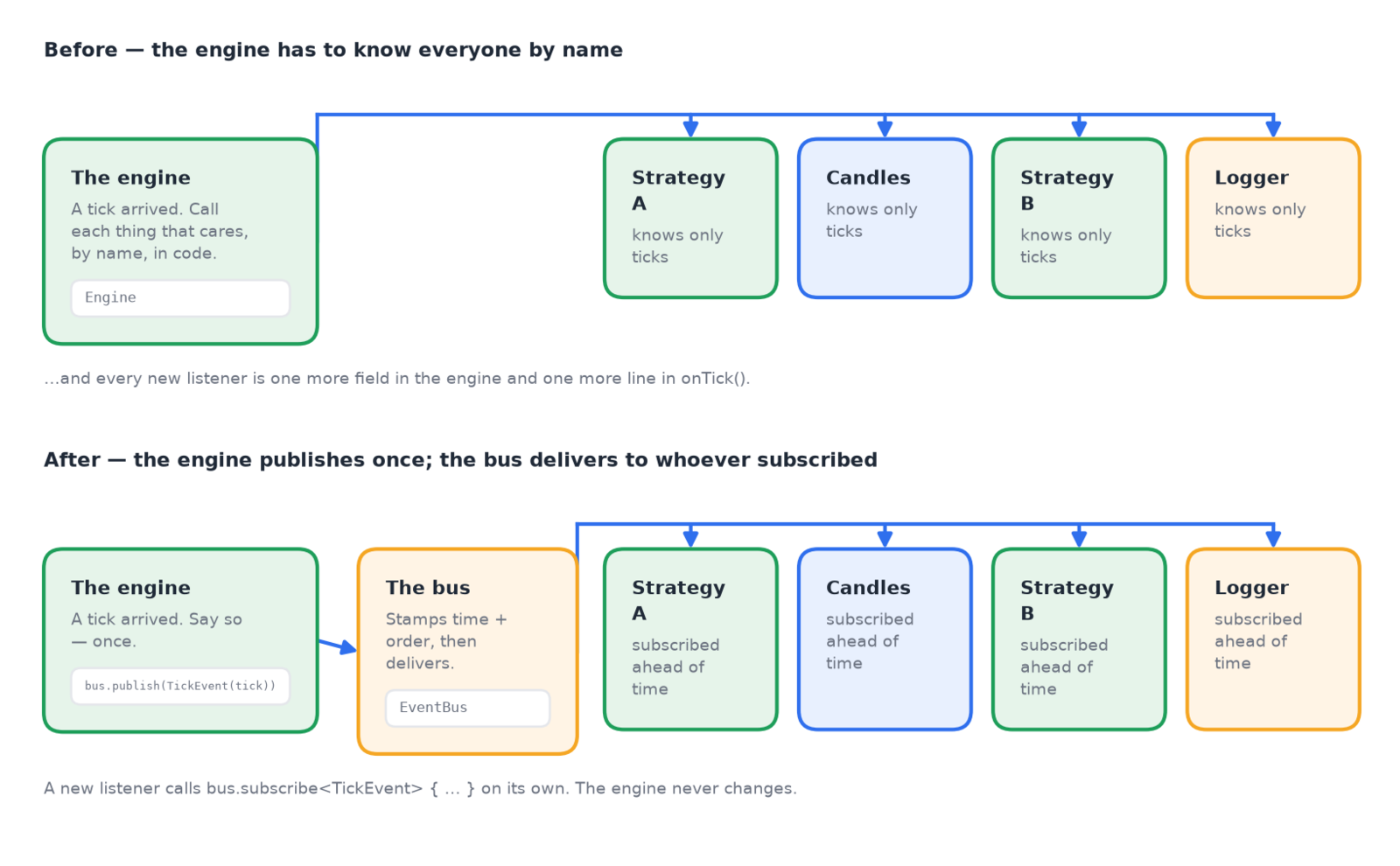
Figure 3.1 — the same four listeners, two designs. Above, every listener costs the engine a field and a line. Below, the engine says “a tick arrived” once and never learns who was listening.
This isn’t a free upgrade, and it’s worth being honest about what it
costs. A direct method call is traceable: you can follow it from the
call site straight into the method body, and a stack trace will tell you
exactly who called what. bus.publish(TickEvent(tick)) gives that up —
the line itself tells you nothing about who’s listening or in what
order. You gain the ability to add new subscribers without touching the
publisher. You lose the ability to know what happens next just by
reading the call site. Left undesigned, that trade can rot into a system
where nobody can say with confidence what order things happen in — a
real risk in something moving money, not an academic one.
What actually gets published#
A subscriber handed “the price moved” needs more than the price. It has to be able to place that fact in time — and when two facts land in the same millisecond, decide which one came first. So every event on qkt’s bus, whatever else it carries, has the same two fields bolted onto it:
sealed interface Event {
    val timestamp: Long
    val sequenceId: Long
}

data class TickEvent(
    val tick: Tick,
    override val timestamp: Long = 0L,
    override val sequenceId: Long = 0L,
) : Event
A sealed interface is a closed set of possibilities — every kind of event
that can exist is declared in one place, so the compiler can check that
code handling events has considered all of them. That closure does real
work here: the code that stamps events is a when over that sealed set,
so adding a new kind of event to the system will not compile until
stamping knows about it. “Every event carries a time and a sequence
number” isn’t a convention anyone has to remember — it’s a build error. But look at the two
fields every event carries regardless of payload: a timestamp, and a
sequence number.
That detail matters more than it looks. Recall why Clock and a
deterministic id source existed in the first place — so “what time is
it” and “what happened first” could be controlled, not left to chance.
The bus is where that control gets enforced for the entire system, not
just for orders:
fun publish(event: Event) {
    val stamped = stamp(event)   // the bus assigns the time and the sequence number — nothing else does
    val handlers = subscribers[stamped.javaClass].orEmpty()
    for (i in handlers.indices) {
        handlers[i](stamped)
    }
}
One authority — the bus, at the moment of publish — decides the timestamp and the ordering for every event that ever flows through it. That’s what makes two replays of the same history produce identical event ordering every single time.
Dispatch is synchronous: publish returns only once every subscriber has
run, on the publishing thread. That is what keeps the order reproducible —
nothing is queued for later delivery on someone else’s schedule — and it
sets a standing requirement on every handler in the system. A subscriber
is expected to be quick and non-blocking, because for as long as one of
them is working, the engine is doing nothing else.
Subscribing is the other half:
inline fun <reified T : Event> subscribe(noinline handler: (T) -> Unit) {
    subscribers.getOrPut(T::class.java) { mutableListOf() }.add { event -> handler(event as T) }
}
The candle builder, the second strategy, the audit logger — each can call
bus.subscribe<TickEvent> { ... } on its own. Engine.onTick never
grows another line for any of them.
Why the order subscribers run in isn’t a detail#
Here’s a case worth sitting with. Say two subscribers both react to “an order was filled.” One updates the position record — you now hold one more unit of whatever was bought. The other reacts to that same fill by cancelling a related order elsewhere, which is now redundant because this fill made it unnecessary.
If the cancellation subscriber happens to run first, it’s making its decision against a position record that hasn’t been updated for this fill yet. Stale state, correct-looking code, wrong outcome. Neither subscriber is individually broken — the defect lives entirely in their order relative to each other, and the type system has no opinion about that.
qkt’s bus makes that order something the code states on purpose:
inline fun <reified T : Event> subscribeFirst(noinline handler: (T) -> Unit) {
    subscribers.getOrPut(T::class.java) { mutableListOf() }.add(0) { event -> handler(event as T) }
}
A subscriber that must see current state before anything consequential
happens registers with subscribeFirst, which puts it at the front.
Everything else uses ordinary subscribe, which appends to the back.
Ordering stops being an accident of who signed up first and becomes a
declared property of the code.
qkt uses exactly one rule here, and it’s the one the example just walked
through: the handler that applies a fill to the books goes first, ahead of
every handler that can touch the venue. And notice why the explicit hook
is genuinely necessary rather than decorative — the venue-touching
handlers are built earlier during startup, so with ordinary subscribe
they would legitimately hold the front of the queue and every one of them
would read a pre-fill book. Registration order would be correct, in the
sense of being exactly what the code asked for, and wrong in the sense
that matters.
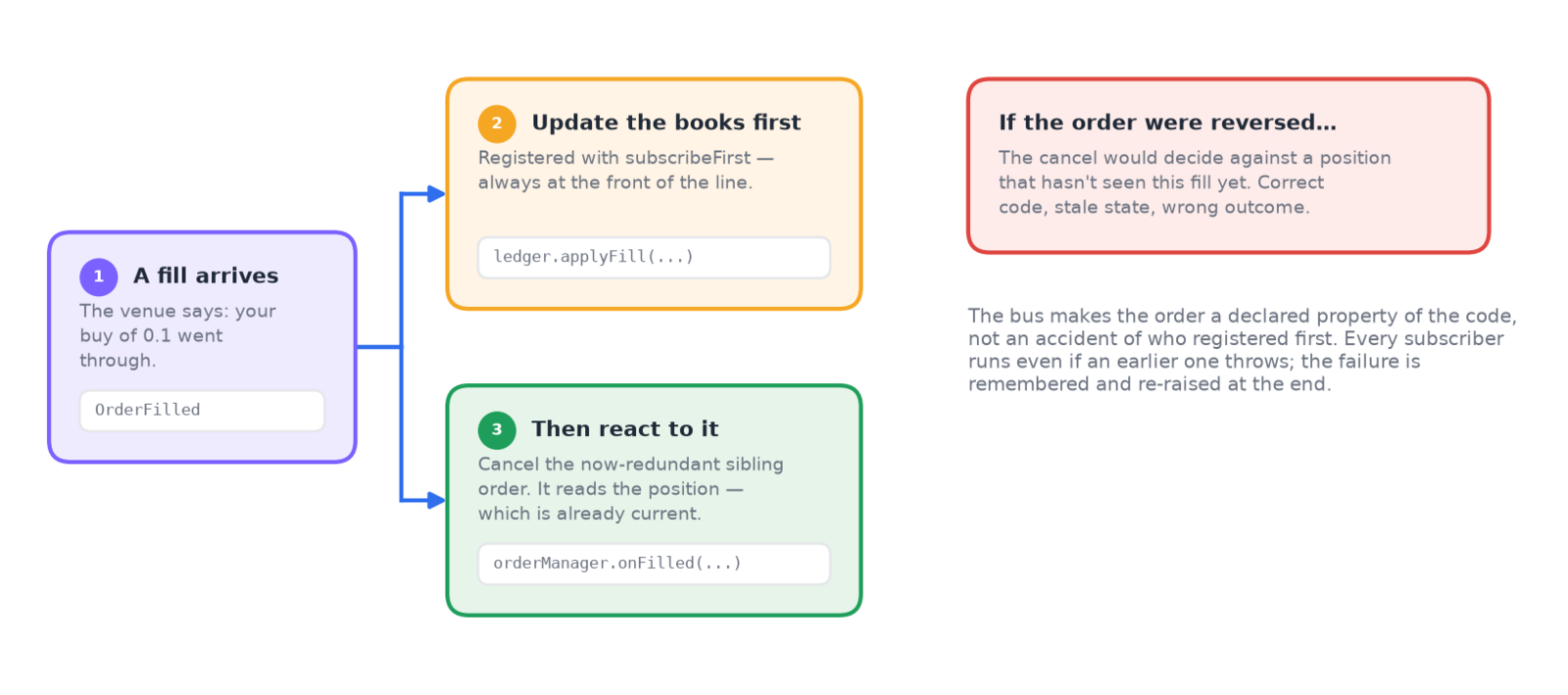
Figure 3.2 — one fill, two reactions, and the only order that is safe. The books must be current before anything reads them to decide.
Failure gets the same deliberate treatment — one subscriber throwing doesn’t silence the others:
for (i in handlers.indices) {
    try {
        handlers[i](stamped)
    } catch (e: Exception) {
        log.error("subscriber {} for {} failed", i, stamped::class.simpleName, e)
        if (firstFailure == null) firstFailure = e
    }
}
Every subscriber still runs even if an earlier one fails. Stopping halfway could leave the system worse off than continuing — imagine an order actually got cancelled out at the venue, but the subscriber that should have updated the local position record never ran because something before it threw. The engine’s picture of the world and the venue’s have now permanently diverged, and nothing will notice on its own.
So the bus refuses to skip anyone. But it also refuses to swallow the failure: the first exception is held, every remaining subscriber runs, and then that exception is rethrown — which is what lets the layer above react properly, halting the engine loop and raising an alert in live trading, or failing loudly in a backtest. Continue, then complain, rather than either crashing halfway through or quietly carrying on.
One thread, even when the world isn’t#
Everything so far assumes a single thread — one continuous line of execution — doing all the publishing. During a backtest replay, that’s simply true: one thread drives the entire replay from start to finish. It stops being automatically true once a real broker is involved. A network reply from an actual venue, or a background process checking prices, arrives on a thread the engine never started.
If that outside thread published directly, two threads could race to stamp and dispatch events at the same instant — breaking the one guarantee the bus exists to provide.
val sink = offThreadSink
if (sink != null && Thread.currentThread() !== engineThread) {
    sink(event)
    return
}
A publish call from any thread other than the one designated engine thread gets queued instead of dispatched immediately; the engine thread drains that queue on its own schedule. Every event still ends up stamped and delivered by exactly one thread, in exactly one order — no matter how many other threads tried to publish at once. During a backtest this condition is simply never true, so the identical code handles both situations without a single branch that treats live and backtest differently.
There’s a subtler version of the same problem at startup, and it’s worth seeing because it’s the kind of gap that only shows up under load. The engine thread doesn’t exist yet while the system is still being built — but broker pollers and recovery logic can start producing events during that construction. So the queue is armed first, before the thread is known: from that moment every publish from every thread is queued rather than dispatched, and the whole backlog drains in order once the loop actually starts. Without that early arming there’s a window, measured in milliseconds, where an event could be dispatched into a half-built pipeline on whatever thread happened to produce it.
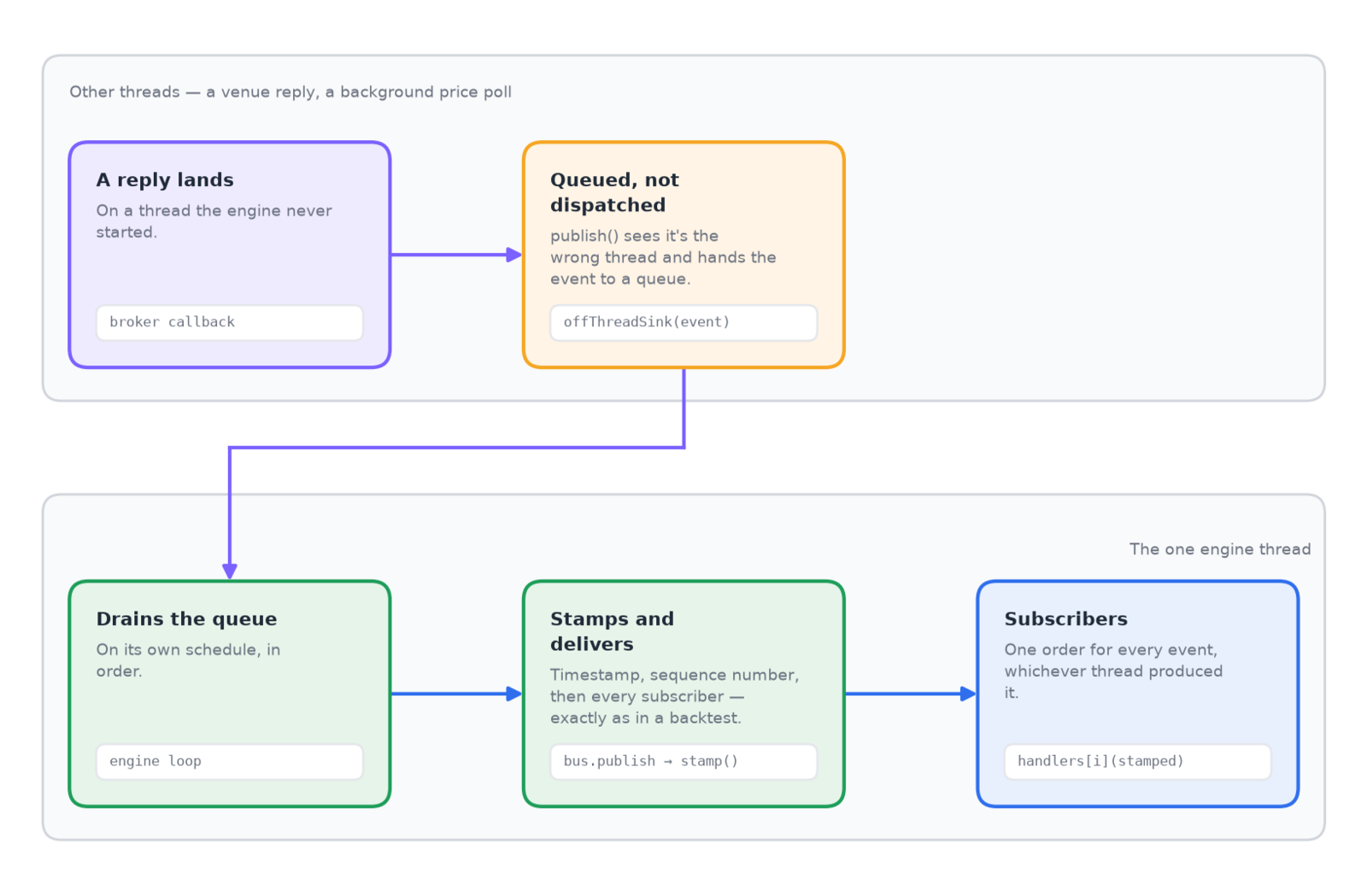
Figure 3.3 — an event produced on the wrong thread waits in a queue; only the engine thread ever stamps and delivers. One thread, one order, even when the world is concurrent.
One order, and what it costs to keep it#
What the bus bought is straightforward: the engine announces that a tick arrived and never learns who cared. New subscribers cost the publisher nothing. And because exactly one component assigns every event its time and its place in line, “what happened, in what order” has a single authority — which is the property the rest of this book quietly depends on.
The costs are just as real, and three of them are worth carrying forward.
Reading bus.publish(...) no longer tells you what happens next; that
knowledge moved out of the call site and into the subscription list.
A subscriber that blocks doesn’t slow one feature down, it stops the
engine. And ordering, the thing this chapter spent its longest section on,
is declared rather than checked — nothing in the type system stops
someone from using ordinary subscribe where the correct answer was
subscribeFirst. The bus makes the right ordering expressible and cheap.
It cannot make it automatic.