Chapter 18 of 25 — contents
- 01What a Trading Engine Actually Is
- 02qkt as a Subject
- 03The Event Bus
- 04Candles
- 05Position Tracking and P&L
- 06The Risk Engine
- 07Exact Arithmetic
- 08Deterministic Replay
- 09Backtest Reporting
- 10Parameter Sweeps and Walk-Forward Analysis
- 11Backtest Fidelity
- 12Why a DSL
- 13Parsing and Compiling
- 14Indicators
- 15Historical Data
- 16The Live Runtime
- 17Brokers
- 18The Order Lifecycle
- 19Resilience
- 20Backtest/Live Parity
- 21Portfolios
- 22Observability
- 23Performance
- 24One Strategy, End to End
- 25What Building qkt Teaches About Trading Systems in General
The Order Lifecycle
One word that means five things#
A strategy says BUY btc SIZING 0.1. Chapter 1 called the result an
order, and for a market order that is almost the whole story: it goes, it
fills, it’s done.
Now write the shape a real strategy actually uses — an entry with a stop below it and a target above. How many orders is that?
The answer is: it depends on the venue, it changes over time, and for a stretch in the middle it is genuinely three orders that must behave like one. The entry might fill in pieces. The stop might be held by the venue or held by the engine. When the target fills, the stop must vanish — and the instant between “the target filled” and “the stop is gone” is a window in which both are live.
This chapter is about that window and its relatives. Not the happy path, which is boring, but the states in between and what happens when two of them are true at once.
Where an order can be#
Start with the vocabulary, because the states are not the obvious ones.
enum class OrderState {
    /** Created locally; not yet submitted. */
    CREATED,

    /** Engine-managed parent waiting for a trigger condition before submission. */
    PENDING,

    /** Submitted to the broker; awaiting acknowledgement. */
    SUBMITTED,

    /** Acknowledged and active on the venue, awaiting fill. */
    WORKING,

    /** Some quantity has filled; the rest is still working. */
    PARTIALLY_FILLED,

    /** Fully filled. Terminal. */
    FILLED,

    /** Cancelled by strategy, engine, or venue. Terminal. */
    CANCELLED,

    /** Refused by the venue. Terminal. */
    REJECTED,
}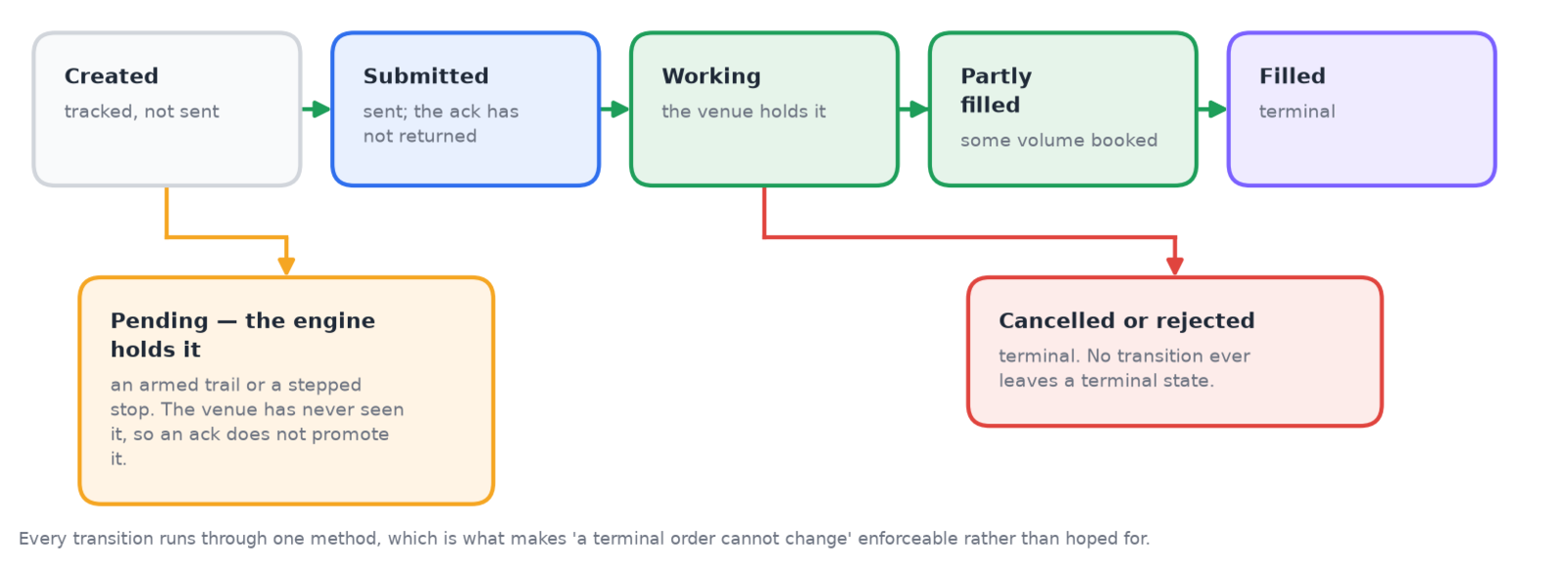
Figure 18.1 — every state an order can occupy. The interesting one is Pending, which is not on the path to the venue at all.
Most of these read as expected. Created means the engine is tracking it but nothing has been sent. Submitted means it has gone out and the acknowledgement has not come back. Working means the venue holds it. Filled, cancelled and rejected are terminal — and terminal genuinely means terminal, because every transition runs through a single method that refuses to move an order out of a final state. That refusal is what makes a delayed duplicate event from a venue harmless rather than corrupting.
Pending is the one worth stopping on, because it breaks the pattern. A pending order is one the engine itself is watching — an armed trailing stop, a stepped stop, a time-tightening stop. The venue has never seen it and never will until it triggers.
Which produces a small, deliberate asymmetry: when an acknowledgement arrives for a pending order, it does not get promoted to working. It stays pending, because “working” means the venue holds it, and the venue does not. Most state machines would treat any ack as forward progress. This one asks what the state actually means and declines.
That distinction matters because of what Chapter 17 established: an engine-held stop only protects while the engine is running. Knowing which of your protective orders live at the venue and which live in your own process is not a technicality — it is the difference between protection that survives a crash and protection that doesn’t.
A bracket is three orders that must act like one#
A bracket, as data, is an entry plus a target price plus a stop specification. But it carries one extra thing worth noticing: the original expressions the strategy wrote for those child prices, not just the numbers they evaluated to.
The reason is a small piece of honesty about fills. A bracket is built before the entry fills, so any child price computed from the entry — “a stop half a percent below” — is computed from an estimate. When the entry actually fills, at whatever price it actually got, the children can be re-anchored to reality rather than to the guess. Keeping the expression rather than only its result is what makes that possible.
How the bracket reaches the venue then depends on Chapter 17’s capability question. Where the venue understands brackets, it goes as one message and the venue attaches the protection to the position. Where it doesn’t, the engine sends the entry alone and holds the two children back until it fills — because sending exits for a position that does not yet exist is how you end up with a resting order that outlives its reason.
The either-or that the venue never promised#
Now the hard part. A stop and a target are one-cancels-the-other: if one fills, the other must not.
On most venues, that relationship does not exist. Two orders rest independently, and the OCO is a fiction the engine maintains. Which raises the obvious question — what happens in the gap between one filling and the cancel for the other arriving?
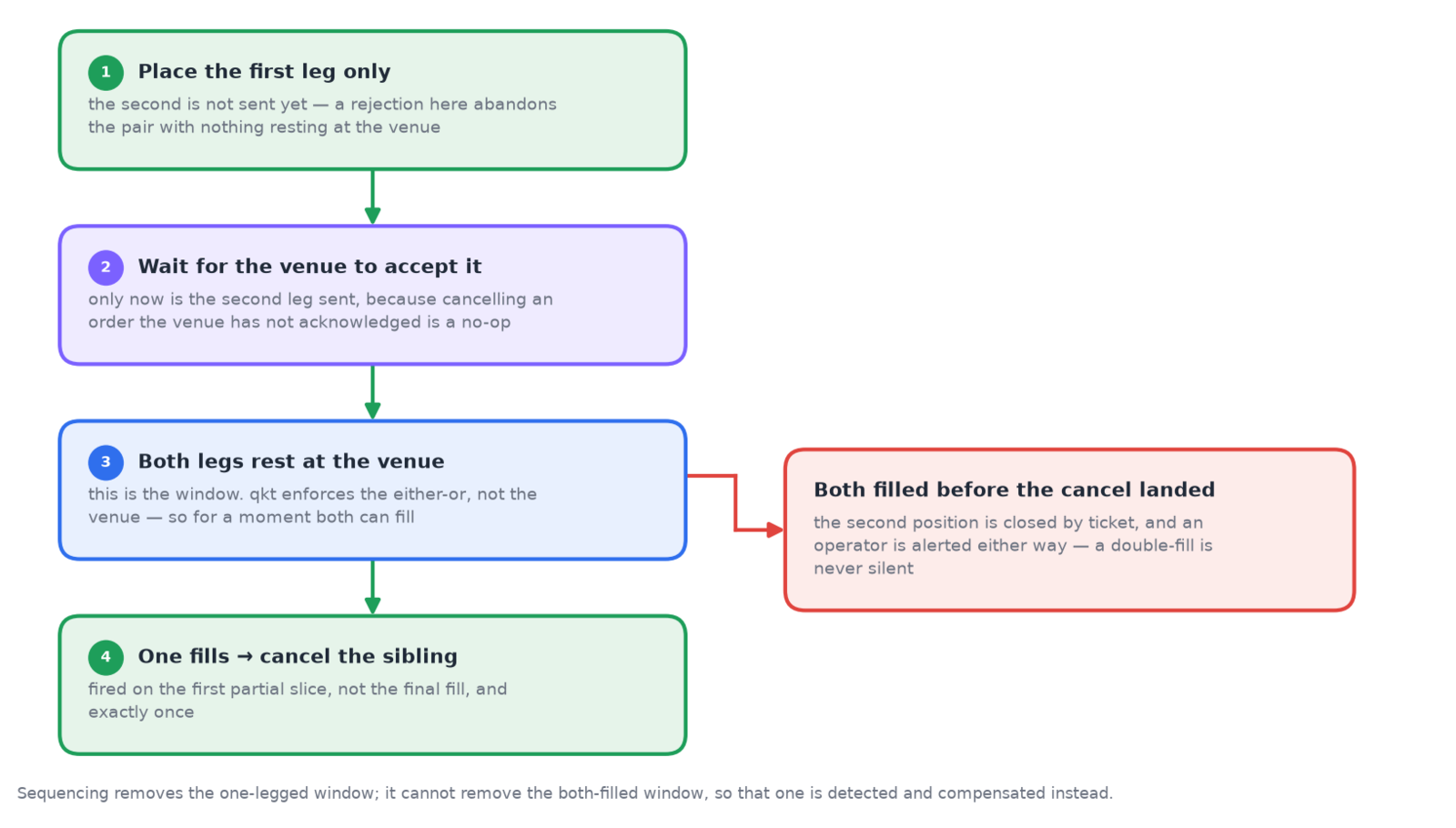
Figure 18.2 — the OCO as it actually happens. Step 3 is a real window, and step 4 is a race against it.
The first decision removes a problem that would otherwise exist at the start. The legs are sequenced, not sent together: leg one goes, and leg two is sent only once the venue has accepted leg one. If leg one is rejected, the pair is abandoned and leg two is never sent at all.
That closes what would otherwise be a nasty asymmetry — one leg resting at the venue with no sibling, protecting nothing, cancelling nothing, just an order sitting there because its partner failed. There is no one-legged window because there is never a moment when only one leg was supposed to exist.
The second decision is subtler, and it is worth taking slowly.
When one leg fills, the other must be cancelled. To cancel an order you have to name it, and the name the venue understands is the ticket it assigned — which arrives with the acknowledgement.
So there is a window where the sibling has been sent but not yet acknowledged. In that window qkt has no venue ticket for it. A cancel sent now names nothing, and the venue discards it silently — no error, no effect, and an order still resting that everyone believes is gone.
The cancellation is therefore deferred until the acknowledgement lands, and fires the moment it does. A cancel that quietly does nothing is worse than one that waits.
And the trigger for all this is the first partial fill, not the final one. The moment the venue commits any volume to one leg, the other is cancelled — because waiting for the leg to finish filling leaves the sibling live for exactly as long as the fill takes.
When the race is lost#
Which leaves the case the design cannot prevent. Both orders are resting. A fast market crosses both levels within one tick, or a cancel is lost. Both fill.
The position is now double the intended size, in two directions or one, and no rule anywhere said this could happen — because the rule was qkt’s, and the venue never agreed to it.
qkt detects this and closes the second position by ticket, which works because Chapter 5’s ledger knows exactly which position that fill created. If there is no ticket to close by — a venue that does not expose them — it refuses to guess, because the alternative is firing a blind opposite-side market order and hoping it lands on the right thing.
Both branches raise an operator alert. That is the part worth keeping: the compensable case is not treated as a non-event just because it was handled. Somebody is told, every time, because an invariant the system depends on was violated by the outside world and that is worth a human knowing even when the software coped.
Deadlines, and a gap worth naming#
An order can carry an expiry — good-till-date. Where the venue supports it natively, the venue enforces it. Where it doesn’t, the engine cancels the order on the first tick past the deadline.
That phrasing hides something, and it should be said plainly:
Engine-side expiry is tick-driven. No independent timer re-checks deadlines, so if ticks stop arriving — a quiet market, a feed outage, a restart — an expired order sits past its deadline until the next tick arrives to notice it. It is cancelled late rather than on time.
There is a nice piece of prevention at the other end of the same feature. An order whose deadline has already passed when it is about to be submitted is rejected locally, before the venue is contacted, and the rejection names both clocks — the engine’s and the wall’s. The reasoning is that such an order could only round-trip into a venue rejection anyway, and a divergence between bar time and wall time is much easier to understand when it is reported as itself than when it arrives disguised as a venue error code.
A sibling check refuses a bracket whose stop or target is already crossed at submission time, and the argument there is pure Chapter 20: such an order would fill and instantly stop out in a backtest, which is not what live would do. Refusing it keeps the two worlds agreeing.
The tripwire underneath#
One last guard, and it is the one that makes the rest safe to trust.
Every protective exit the engine manages is supposed to reduce a position. That is the whole point of it. So after any exit fills, the engine checks the net position — and if the exit somehow left exposure sitting on its own side, meaning the “exit” actually opened or increased something, it raises an alert immediately.
This is a backstop rather than a mechanism: nothing in the design should ever trip it. Its job is to make sure that if some future path does break the invariant, it breaks loudly on the first occurrence instead of accumulating quietly. The related sweep retires protective exits that a netting fill has orphaned — a resting stop whose position no longer exists would otherwise eventually fire as a naked entry in the opposite direction, with no protection of its own.
The state it takes to keep a bracket honest#
What it bought is that a strategy writes one bracket and gets one bracket’s worth of behaviour, on venues that support none of it, with every window where that could break either closed by sequencing or detected and compensated.
What it cost is a genuinely large amount of state. Parent and child links, sibling links, deferred cancels, one-shot guards, per-order satellite maps for trailing high-water marks and stack tiers — all of it living in the engine because the venue would not hold it. Every one of those maps has to be torn down when an order dies, and one that isn’t leaks for the life of the process.
And the honest gap: a GTD order’s deadline is only as timely as the next tick. Everything else in this chapter defends against the outside world misbehaving. That one is a case where the engine’s own liveness is the limit, and the design says so rather than implying a timer that isn’t there.