Chapter 17 of 25 — contents
- 01What a Trading Engine Actually Is
- 02qkt as a Subject
- 03The Event Bus
- 04Candles
- 05Position Tracking and P&L
- 06The Risk Engine
- 07Exact Arithmetic
- 08Deterministic Replay
- 09Backtest Reporting
- 10Parameter Sweeps and Walk-Forward Analysis
- 11Backtest Fidelity
- 12Why a DSL
- 13Parsing and Compiling
- 14Indicators
- 15Historical Data
- 16The Live Runtime
- 17Brokers
- 18The Order Lifecycle
- 19Resilience
- 20Backtest/Live Parity
- 21Portfolios
- 22Observability
- 23Performance
- 24One Strategy, End to End
- 25What Building qkt Teaches About Trading Systems in General
Brokers
Every venue is a different animal#
A strategy says buy gold, with a stop below and a target above. That sentence is venue-agnostic. Nothing about it is.
One venue will take that whole shape in a single message and attach the stop and target to the resulting position, then enforce them itself. The next has no concept of a bracket at all — you may send an entry, and you may send a stop, and keeping them related is your problem. One numbers every position with a ticket you must name to close it. Another lets you choose your own identifier for an order and hands it back. One tells you about fills by pushing them down a socket; the other must be asked, on a timer, forever.
They also disagree about things a strategy would consider settled. Whether a second position on the same symbol is a separate thing or folds into the first — Chapter 5’s netting-versus-hedging split — is a property of the venue. So is whether an opposite-side order closes a position or opens a new one.
The job of a broker layer is to absorb every one of those differences without letting any of them leak upward into a strategy, while also not lying about them. Those two goals pull against each other, and the interesting decisions in this chapter are all on that seam.
A narrow interface with honest holes#
The first decision is what a broker is required to be able to do, and the answer is: almost nothing.
interface Broker {
    val name: String

    fun submit(request: OrderRequest): SubmitAck

    /** Cancels the working order with client-assigned [orderId]. No-op if already terminal. */
    fun cancel(orderId: String)

    fun modify(orderId: String, changes: OrderModification): SubmitAck =
        throw UnsupportedOperationException("$name does not support modify")

    val supportsPositionTickets: Boolean get() = false

    fun capabilitiesFor(symbol: String): Set<OrderTypeCapability> = capabilities
}
Submit, cancel, and a name. That is the required surface. It is deliberately small because the engine already owns everything around it — order management, position tracking, P&L attribution, risk. A broker is not asked to be a trading system. It is asked to be a mouth and an ear.
Look at what the optional parts do when a venue lacks them. modify
throws by default, naming the broker. supportsPositionTickets
defaults to false. Neither one quietly returns something plausible.
That is the design’s whole character in two default implementations:
a venue that cannot do a thing says so, in a way the caller cannot
mistake for success.
Everything beyond the minimum is optional, and this is where the design gets careful. An optional capability does not silently return a plausible answer when a venue lacks it. Ask a broker that cannot report position tickets for its tickets and you get a refusal or an explicit empty answer, not a fabricated list. Ask one that cannot say whether the account nets or hedges and it answers unknown — a real value with real meaning, which Chapter 5’s planner then treats conservatively.
Capabilities that arrived later live in separate opt-in interfaces rather than as new methods on the main one, for a stated reason: adding a method to the core interface would break every broker implementation compiled against an earlier release. A venue integration someone wrote last year should keep working when the engine learns a new trick it does not have.
Asking, rather than assuming#
Now the mechanism that makes one bracket work on two incompatible venues.
Before deciding how to send a shape, the engine asks what the venue can actually do. The vocabulary of that question is a closed set:
enum class OrderTypeCapability {
    MARKET, LIMIT, STOP, STOP_LIMIT, BRACKET, IF_TOUCHED,
    MODIFY, OCO, TRAILING_STOP,
    MULTI_POSITION_PER_SYMBOL, POSITION_MODIFY,
}
Note MULTI_POSITION_PER_SYMBOL in that list — that is Chapter 5’s
hedging-versus-netting distinction, arriving here as a thing the engine
must ask about rather than assume.
And it asks per symbol, not per broker.
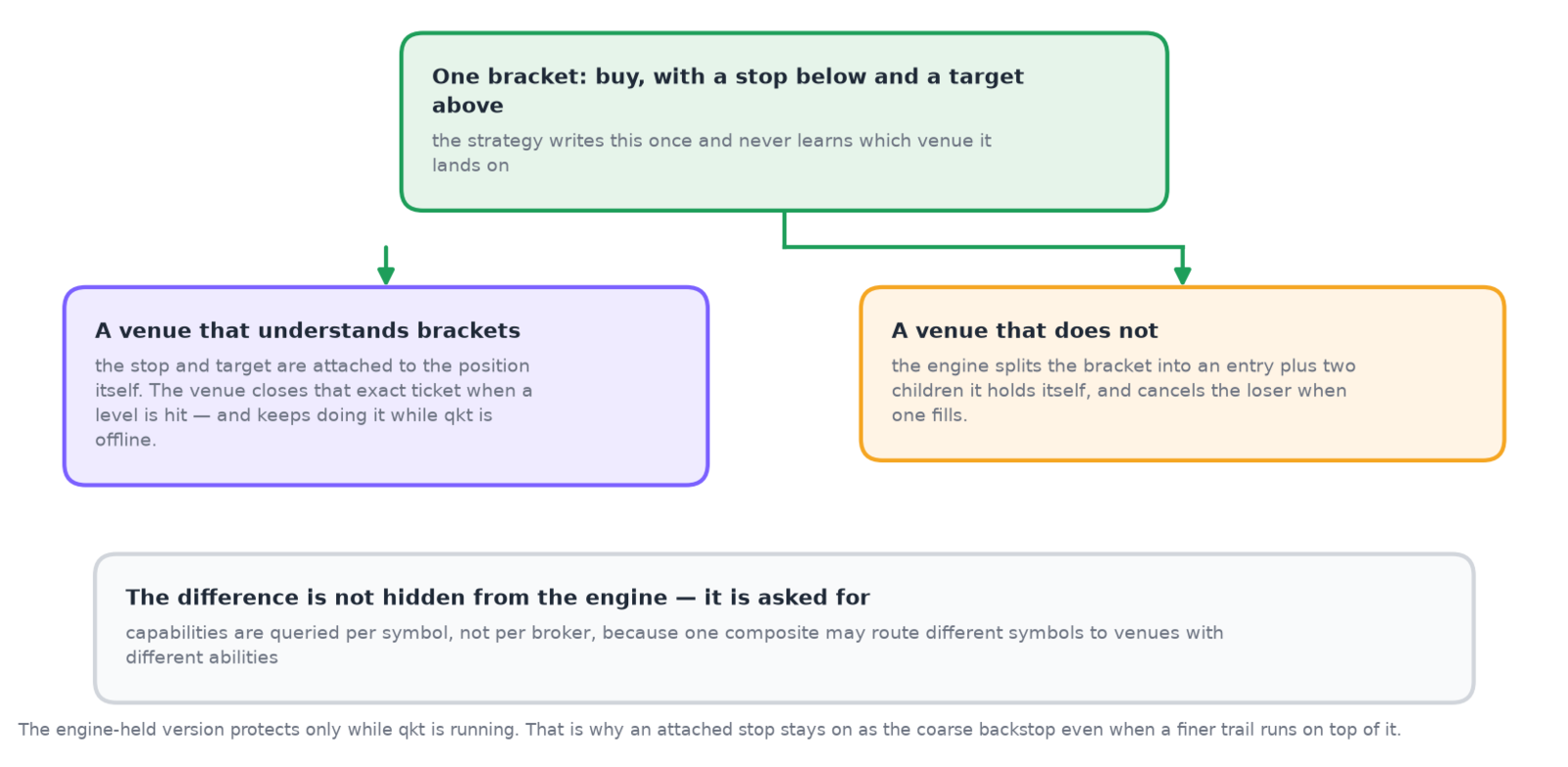
Figure 17.1 — the same bracket, two decompositions. The strategy that wrote it never finds out which one happened.
The per-symbol part is not fussiness. A single deployment can route gold to one venue and a crypto pair to another, so “what can this broker do” is not a well-formed question — only “what can this broker do for this symbol” is. Asking a composite broker for its capabilities without naming a symbol raises an error rather than returning a merged best guess, which forces every caller onto the question that has an answer.
When the venue understands brackets, the stop and target are attached to the position itself, and the venue enforces them. That has a property nothing the engine does can match: it keeps working while qkt is not running. A stop attached at the venue survives a restart, a crashed process, a lost network. An engine-held stop is a monitor, and a monitor that isn’t running isn’t monitoring.
When the venue does not, the engine decomposes the bracket into an entry plus two children it holds itself, and cancels the loser when one fills — the OCO machinery of the next chapter.
There is a lovely piece of restraint in the capability list. One venue can
technically achieve an OCO with two separate calls, and the broker
declines to advertise the capability anyway, on the grounds that
claiming it would falsely promise venue-atomic cancellation. Two calls are
not one call. Between them there is a window in which both orders are
live, and a caller told “this venue does OCO” would reasonably assume
there isn’t. Refusing to claim a capability you can only approximate is
the same instinct as null meaning unsupported rather than zero.
A similar honesty applies to trailing stops: the capability is absent because the venue’s gateway does not actually apply the trailing distance it is sent, so the engine emulates the behaviour instead. The capability list describes what the venue will genuinely do, not what its API accepts.
Two ways to find out what happened#
Venues also differ in how they tell you about fills, and the two shapes have genuinely different failure modes.
One venue is polled: every second, the engine asks for the current positions and pending orders, and works out what changed. The other streams: a socket pushes executions as they happen, with a periodic reconciliation running underneath as a safety net.
Polling means fill latency is bounded by the poll interval, and it means some outcomes are ambiguous — a submit that fails with a network error may or may not have reached the venue, and the only way to find out is to look. The handling of that is worth quoting for its reasoning: telling the strategy the order was rejected makes it re-fire and double the position, so the engine resolves the outcome against venue truth before reporting anything. An honest “I don’t know yet” beats a confident wrong answer in either direction.
Streaming is faster and brings its own problem: the same execution can be delivered twice. Both approaches therefore need deduplication, and — a nice detail — they need different deduplication. The streaming venue gives every execution a unique id, so the engine keeps a bounded set of recently-seen ids. The polled venue has no such id, so the engine works with time-windowed maps of tickets instead. The same requirement, two mechanisms, because the venues offer different raw material.
One thing both share: submit returns immediately with an optimistic
acknowledgement, and the real outcome arrives later as an event. The
engine thread never waits on a network round trip, because Chapter 16
established that the engine thread waiting is the engine not trading.
Several venues at once, and no safety net#
A deployment can use more than one venue, and a composite broker routes by symbol — a list of patterns, first match wins.
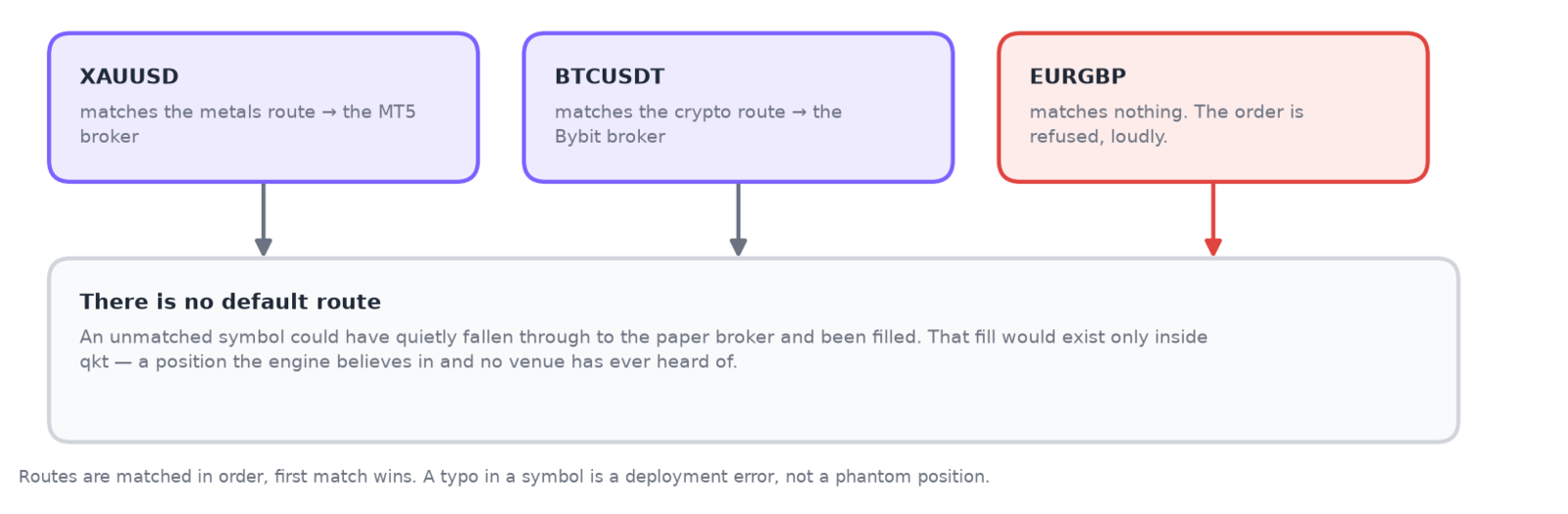
Figure 17.2 — routing with no default. An unmatched symbol is a deployment error, surfaced immediately.
The decision worth dwelling on is the absence of a fallback. There is no default route, no “if nothing matches, use the paper broker.” A symbol that matches nothing produces a hard failure.
Consider what a fallback would do. A typo in a symbol name, a stale profile, a half-finished deployment — any of those produce a symbol with no route. With a fallback to the simulator, that order gets filled. Cleanly. The engine now holds a position, tracks its P&L, manages its stops, and reports it in every status command — and no venue anywhere has heard of it. It is a position that exists entirely inside the software, and the first time anyone finds out is when the real account fails to match. Failing at deploy is enormously better than a phantom.
The same principle governs reads. When a composite asks all its venues for their open positions and one fails, the answer is not “here is what the others said.” It re-raises, because a caller reconciling against a silently-partial snapshot concludes it is flat on that venue and starts trading on that belief. A partial truth presented as a whole one is worse than an error.
Absorbing the differences, and carrying them#
What it bought is that Chapter 12’s strategy file means the same thing on every venue qkt supports, without pretending the venues are the same. The differences are asked about explicitly, resolved as early as possible, and never smoothed into a claim the venue will not honour.
What it cost is spread across three places. The engine carries a second implementation of things a good venue does natively — OCO, trailing — because some venues do not, and engine-held protection has a strictly weaker guarantee than venue-held: it only works while the process is alive. Every optional capability is a branch, and branches are places two paths can drift. And a narrow interface means the engine, not the broker, carries the complexity — which is the right place for it to live, but it is a large amount of complexity to be carrying.
There is one honest gap worth naming rather than glossing. qkt brokers list shows MT5 profiles and nothing else, even though the engine speaks
to more than one venue. The interface is general; that particular piece of
operator tooling has not caught up with it. Small, real, and better said
than discovered.